
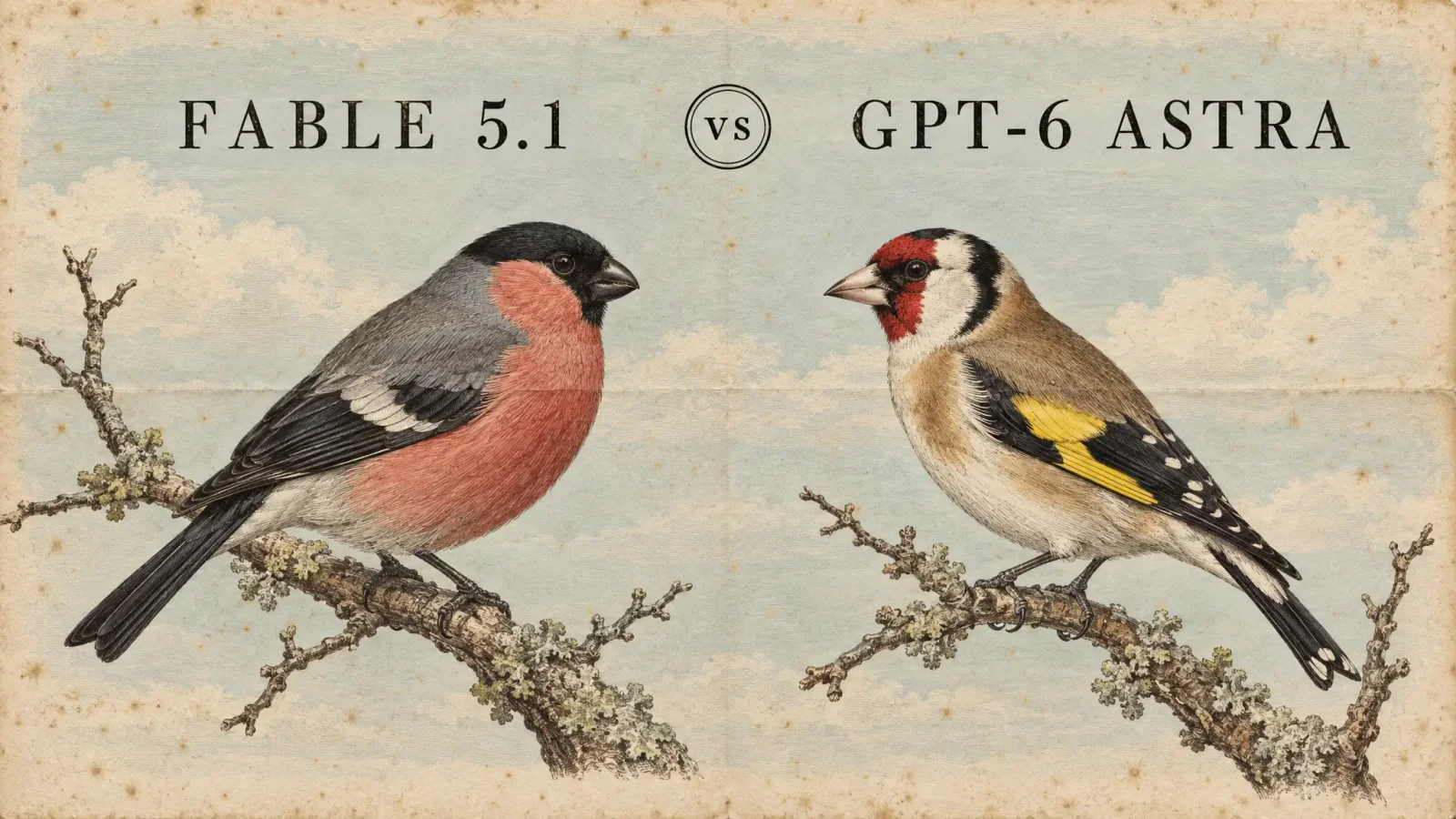
Fable 5.1 vs GPT 6 Astra is the AI comparison developer forums have been running nonstop since early September, and the honest answer is that neither model wins outright. Anthropic shipped Claude Fable 5.1 on September 1 to 2, 2026, and OpenAI followed two days later with GPT-6 Astra on September 3, and independent testers have spent the two weeks since arguing over which one actually deserves the top spot.
Key takeaways
Anthropic's Claude Fable 5.1 and OpenAI's GPT-6 Astra launched within days of each other in early September 2026, and no single benchmark or hands-on test has both models agreeing on a winner.
On daily.dev's hands-on coding tests, Fable 5.1 scored 92.5% on eight KingBench 3 tasks against Astra's 90%, and won or tied three of four larger app builds.
Running those same daily.dev tests cost about $198 in tokens for Astra versus $113 for Fable 5.1, a roughly 75% gap that the leaderboard score alone did not predict.
Artificial Analysis's independent Intelligence Index puts Fable 5.1 ahead on both overall intelligence and coding agent scores, even though OpenAI's own launch materials show Astra ahead on most rows.
For creators, the real story isn't which model "wins," it's that benchmark tables from the vendors themselves should be treated as marketing, not verdicts.
What actually happened this week
Two frontier labs shipped flagship models almost on top of each other. Anthropic's Claude Fable 5.1 arrived first, a release MagicShot covered alongside its sibling model Mythos 5.1. OpenAI answered with GPT-6 Astra, which OpenAI describes as its most intelligent and aligned model yet, with capabilities across computer use, coding, cybersecurity, and science, a launch we broke down in detail here. Within 48 hours, developers on Reddit were running both models through identical prompts and posting the results side by side.
Two threads capture the shape of that reaction. In r/OpenAI, a poster set Fable 5.1 and Astra loose on the same 3D Blender scene-building task, while a r/ClaudeAI thread pitted the two models against each other on 2D sprite generation, the kind of asset work game developers repeat dozens of times a day. Neither thread produced a consensus, and that split has turned out to be the pattern for this entire launch cycle.
Fable 5.1 vs GPT 6 Astra on coding benchmarks
The most detailed head-to-head so far comes from daily.dev, which ran both models across eight coding tests on the KingBench 3 suite plus four larger, full app builds. GPT-6 Astra scored 90% on KingBench 3, good for third place, while Fable 5.1 scored 92.5% and took first, a two-point gap across the eight tests. The bigger separation showed up once tasks got longer: on the four full app builds, Fable 5.1 won two clearly, tied one, and won the fourth by a small margin, while Astra shipped a broken TMDB integration in a terminal app and a non-functional agent inside an Obsidian clone.
Independent evaluators tell a similar story once the setting shifts away from vendor-run tests. Artificial Analysis scores Fable 5.1 at 66 on its Intelligence Index at maximum effort against Astra's 61, and 70 against 67 on the Coding Agent Index, even though OpenAI's own launch chart shows Astra ahead on almost every row it publishes. The same evaluator also clocks Fable 5.1 at 65 tokens per second against Astra's 53.9, and lists Fable 5.1 as the cheaper model to run.
Astra does win some fights that matter to specific workflows. On Terminal-Bench 4.0, Astra scores around 57.9% against Fable 5.1's 55.8% and GPT-5.6 Sol's 37.3%, a benchmark built around real terminal and file-system tasks rather than isolated coding puzzles. The pattern that keeps repeating: Astra edges ahead on narrow, tool-heavy tasks, while Fable 5.1 holds its lead on anything that requires tracking a large codebase without losing the thread.
What it actually costs to run each model
Benchmark scores rarely tell you what a project will cost, and this launch cycle is a clean example of why that gap matters. Testing GPT-6 Astra through Codex with extended thinking cost about $198 in tokens on daily.dev's benchmark set, roughly 75% more than the $113 spent running the identical tests through Fable 5.1. Those are token costs for specific test runs rather than monthly subscription prices, and actual spend will vary by agent setup and thinking level, but the direction of the gap has held across the testers who published numbers.
The same reporting flags a habit that adds friction on top of the token spend. GPT-6 Astra tends toward a familiar grid layout with a green-tinted aesthetic, often turns simple requests into full landing pages, and calls tools eagerly even during casual chat, which pushes runtime and the bill higher for tasks that never needed the extra scaffolding.
Why the benchmark tables disagree with each other
Three launch tables went up in the same week, and each one has a different model on top, which is really the headline finding here. OpenAI's own launch numbers show Astra beating Fable 5.1 on almost every row, Artificial Analysis puts Fable 5.1 first on overall intelligence and its coding agent index, and LLM Stats scores the same two models and produces yet another ordering. None of those tables is wrong exactly, they measure different things under settings that outside testers cannot fully reproduce.
The most publicized Astra number, its result on ARC-AGI-3, is the clearest example of how much a benchmark's configuration can change the story. Astra's widely quoted 99.9% on ARC-AGI-3 came from OpenAI's own configuration, while a standard harness put it closer to 62.7%, a reminder that a single headline score is a poor substitute for reading the methodology behind it.
Where each model actually wins
Set the leaderboard arguments aside and a workflow pattern is easy to see. Astra tends to be sharper and faster on narrow, well-defined jobs, while Fable 5.1 holds up better across long, multi-step work. One practitioner who tested both models on 15 real assignments, from presentations to browser automation, found Fable's wins clustering around the presentation, sales copy, and reference-based website tasks, while leaning toward Astra for day-to-day work overall, and kept using both rather than picking one. The rule this round of testing points to: reach for Astra on fast, narrow, tool-driven tasks, and for Fable 5.1 on anything long or multi-file where the model has to remember what it built ten steps earlier.
What this means for creators using AI tools
This launch cycle is a reminder that model comparisons move fast and vendor charts are marketing first, evidence second. If you build with AI tools for a living, the safer habit is checking an independent evaluator, not just a company's launch page, before switching your stack. The same caution applies to image and video generation, where MagicShot's AI Art Generator and Text to Video tools sit downstream of the same frontier model churn, since releases from OpenAI, Anthropic, and Google routinely reshuffle what's fastest or cheapest to run.
It's worth watching how this plays out against other recent releases, too. Claude Opus 4.8 beat GPT-5.5 on most benchmarks just months before this launch, and tools like Sakana Fugu now orchestrate multiple models such as Claude, GPT, and Gemini together precisely because no single model wins every task. Fable 5.1 and Astra look set to join that same rotation rather than settle the argument for good.