
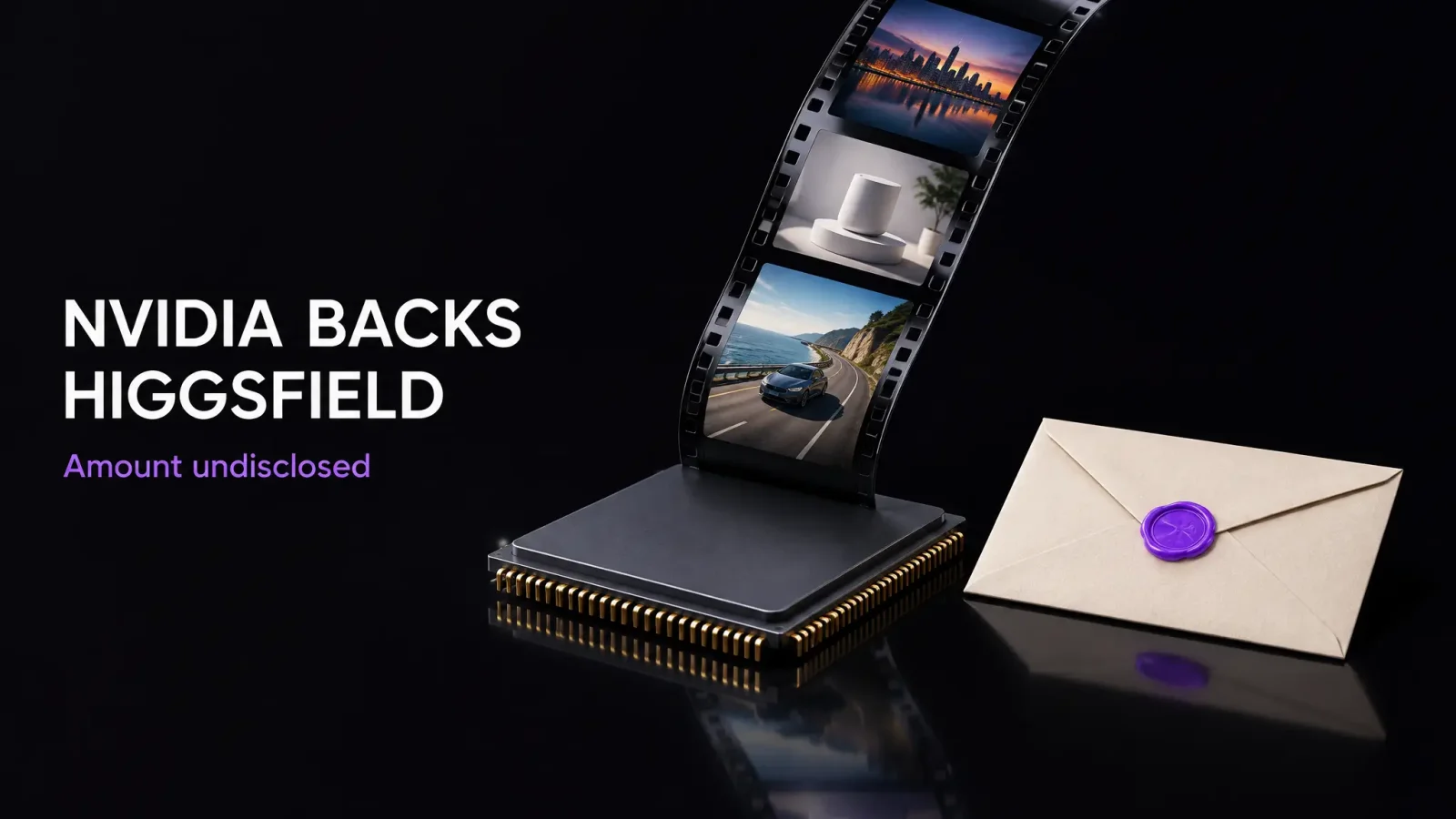
Higgsfield, the AI image and video platform behind tools like Genjutsu, announced on October 23 that NVIDIA and TCV have joined an extension of its Series B. The company did not say how much the two investors put in. The round itself was led by DST Global in August, with Goldman Sachs Alternatives, Tribe Capital, AI Capital Partners, Smash Capital, GFT Ventures and Valor Capital also in. Reports at the time put that August raise at $400 million at a $5.4 billion valuation, figures Higgsfield has not confirmed in its own announcement.
The timing was not an accident. The news went out from San Francisco and Astana on the day NVIDIA CEO Jensen Huang made his first visit to Kazakhstan, where a large part of Higgsfield's engineering team is based, during the country's national AI Month.
The numbers, and where they come from
Everything below is Higgsfield's own reporting. None of it has been independently audited, and the company is private, so treat these as claims rather than results.
More than $1 billion in annualized revenue run rate, reached in September, 18 months after launch.
More than 40 million users across 238 countries and territories. The US is the biggest market, Europe the biggest region.
12 trillion tokens and 150 million generations a month on the platform.
Enterprise revenue growing more than 100 percent month over month, with business revenue under contract up tenfold since June.
More than 150,000 creators have finished lessons in Higgsfield Academy, its AI filmmaking course.
A run rate is twelve times one month's revenue, so "passed $1 billion annualized in September" means a September of roughly $85 million. That is a lot for an 18-month-old consumer and prosumer product, and it is why TCV and NVIDIA showed up.
Why NVIDIA wants in
NVIDIA's Rev Lebaredian put the logic plainly in the announcement: "AI factories produce intelligence in the form of tokens and the application layer is where those tokens become useful." Higgsfield is an application that burns an enormous number of tokens on NVIDIA hardware, from L40 and A40 cards up through Hopper and Blackwell, with an expansion to Vera Rubin already underway. It also used NVIDIA Blackwell Ultra infrastructure to make Kök Börü, a 15-minute animated short that it open-sourced as a free Academy course.
Higgsfield's own pitch leans on a yield comparison it attributes to industry benchmarks: generative video earns $30 to $150 per million equivalent tokens, against $0.15 to $0.60 for text. If that holds, video is the most valuable thing you can do with a GPU, and NVIDIA investing in the apps that prove it is a reasonable bet.
What it means if you make videos for a living
Three practical things.
More models, faster. The stated uses of the money are product development, global infrastructure, hiring and go-to-market. For users that usually means new model options, faster generation, and more aggressive pricing to keep the growth curve going. Expect Higgsfield to keep adding third-party models next to its own.
Ad tooling is the direction. The announcement highlights "up to 100 ad variants per campaign concept" and more than 100 percent monthly enterprise growth. Higgsfield is steering toward brand marketers and agencies, which is where the money is. If you are a solo creator, watch whether the free and starter tiers get squeezed as the enterprise side grows.
Credits and cost transparency matter more as platforms scale. Higgsfield's CEO Alex Mashrabov framed the opportunity as "every brand, studio and creator now needs more visual content than traditional production can supply." The flip side is that creators are now buying video by the credit from several platforms at once, and the ones that show the cost before you generate are easier to budget. That was the main difference we found when we compared Higgsfield Genjutsu with Go Viral AI earlier this month: Genjutsu wins on reference-image limits and listed per-clip prices, Go Viral AI on seeing the cost before you hit generate and using the same credits across every other MagicShot tool.
Read the Genjutsu vs Go Viral AI comparison
What to watch
The number that matters next is whether Higgsfield publishes a confirmed round size and valuation, which would tell us how much of the $1 billion claim investors priced in. Also worth watching: whether the Vera Rubin expansion shows up as lower generation prices, and whether the company's push into ad variants changes what the creator tiers include. We will update this post if the amount is disclosed.