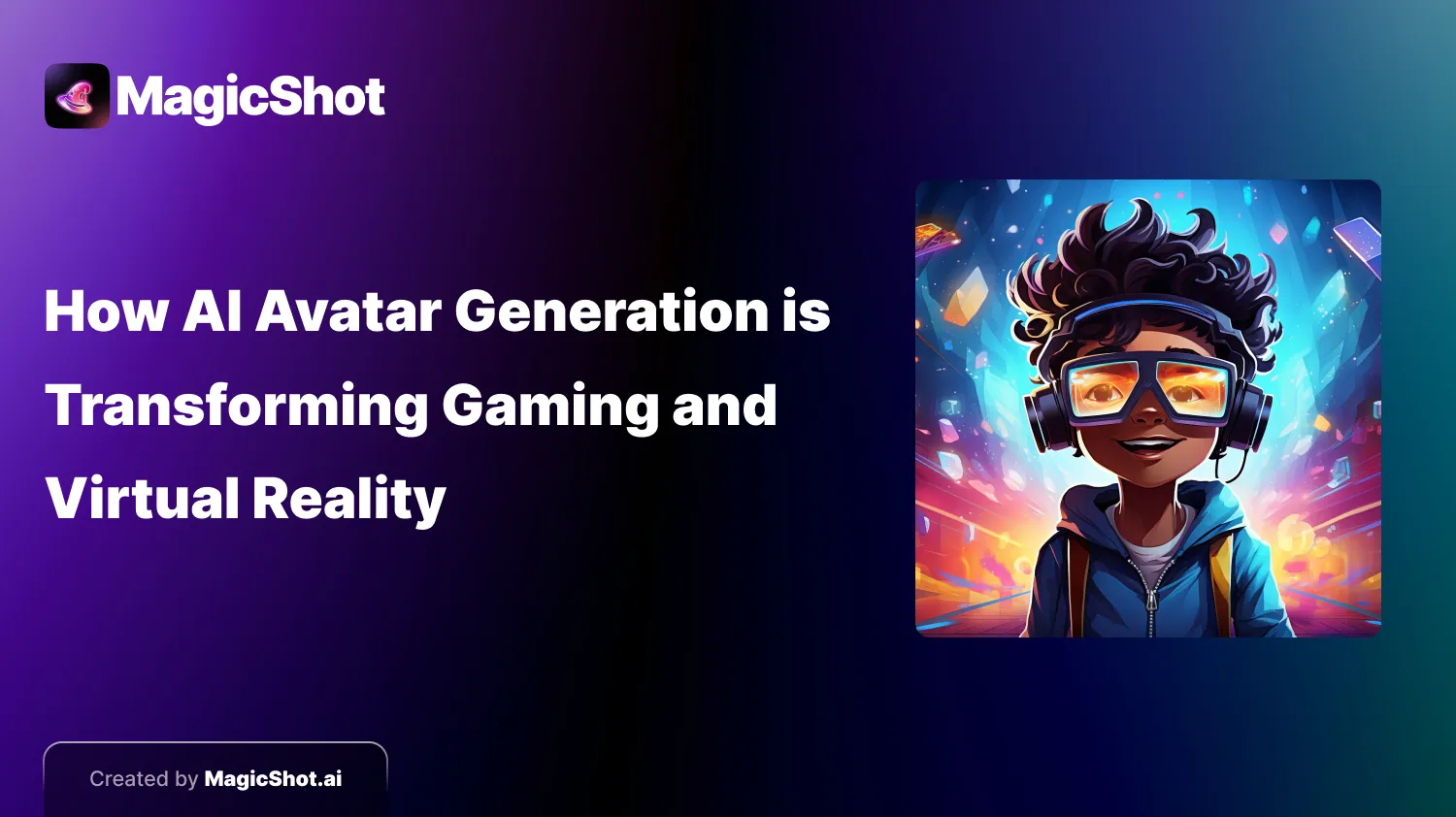
Talk about AI avatars in games and VR and you will hear big promises: lifelike digital selves, characters that think for themselves, a persistent metaverse. Some of that is real today and some is still a demo. This post separates the two, so you know what a player, a creator or a studio can actually use now.
What an avatar does in a game or headset
In a game, your avatar is a character you control and often customise. In VR it is your body in the room, and other people read your mood from how it moves. That is why avatar quality matters more in VR than in a flat screen: a slightly wrong face or stiff gaze feels uncomfortable up close.
What AI actually adds
Faster character creation. Generating a face, outfit or concept from a photo or a text prompt, instead of dragging fifty sliders. Tools like an AI avatar generator work along these lines.
3D assets and props. Models of items, accessories and scenery from an image or prompt. See the 3D object generator for a way to try this.
Likeness from a scan. Some systems build a 3D avatar from a few photos or a phone scan. Apple's Personas on Vision Pro, Meta's avatars and cross-game avatar platforms such as Ready Player Me are well-known examples of this idea in different forms.
Expression and animation. Models that map your face, voice or controller input onto an avatar so it blinks, smiles and lip-syncs.
Non-player characters. Studios and researchers are testing NPCs that hold open-ended conversations using language models. This is an active area of experiments, and few shipped games rely on it fully.
A note on the technology
Older generators used GANs, which pit two networks against each other. Most current image and avatar tools are built on diffusion and related models, with 3D handled by techniques such as scanning and neural rendering. You do not need the detail to use the tools, but it explains why results vary in quality and consistency.
What this means for different people
Players. More ways to make an avatar that looks like you, or deliberately does not. The practical limit is whether a game lets you import one.
Indie developers and modders. The biggest gain. Concept art, portraits, textures and basic assets that once needed a team can be drafted in hours. You still need human review for style consistency and rigging.
Studios. AI is mainly speeding up concepting and asset variation. Questions about training data, credit for artists and player expectations are live issues.
VR social users. Stylised avatars are often more comfortable than almost-realistic ones, because near-human faces can feel uncanny.
Where it is still limited
Real-time quality. Photoreal, expressive avatars that run smoothly on a headset are hard, and compromises are common.
Consistency. Keeping one character identical across scenes and outfits takes care.
Rigging and animation. A generated model still needs a skeleton and clean topology to move well in an engine.
Rights. Check licence terms before shipping generated assets in a commercial game.
Ethics worth taking seriously
Avatars built from someone's real face and voice need consent. Deepfake-style impersonation, age and identity misrepresentation in social spaces, and the storage of face scans all raise privacy questions. Use tools with clear terms, and avoid creating a likeness of anyone without permission.
Where avatars are heading beyond games
The same tools support brand characters and creators. See AI avatars in digital marketing and AI avatars for boosting your brand. For a tool comparison, read the top AI avatar generators.