
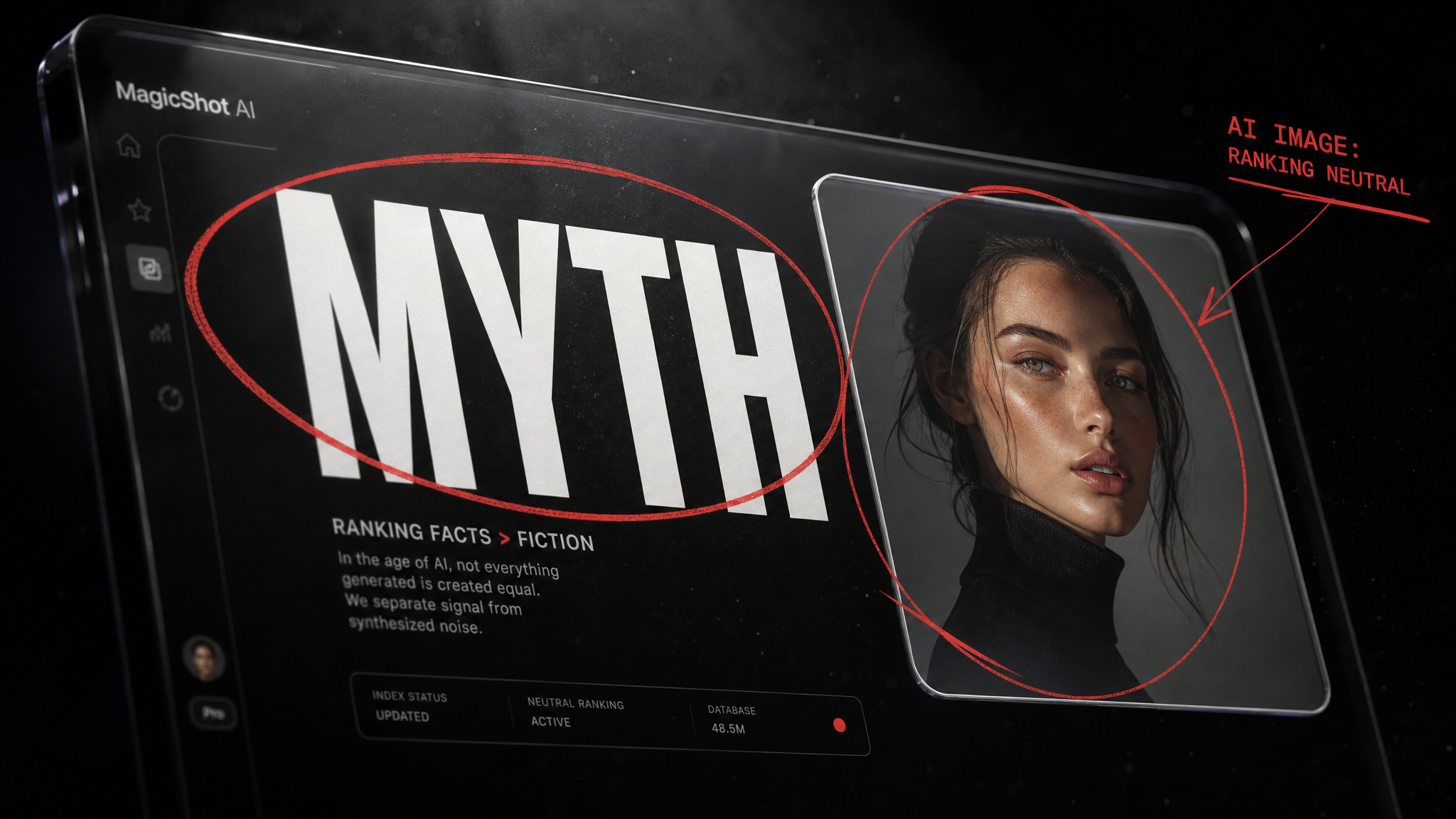
Short answer: no, Google does not penalize AI-generated images just because a machine made them. In an August 2025 Q&A with Kenichi Suzuki, Google's Gary Illyes said there's no ranking penalty and no direct SEO impact from using AI images alongside legitimate content. The data backs him up: an Ahrefs analysis of 600,000 top-ranking pages found 86.5% contained some AI-generated content, with a correlation between AI usage and ranking position of just 0.011 — statistically zero. What Google actually judges is quality, helpfulness, and whether you're trying to manipulate rankings. This guide covers what that means in practice, how SynthID and C2PA metadata now flag AI images in Search, and the disclosure and image SEO steps that keep your visuals visible.
The fear is understandable. Everyone remembers the updates that de-ranked thin, mass-produced pages. But the enemy there was low effort, not the tool. If your images earn their place on the page, you're fine. If they're filler, that's a different problem, and it would have been a problem with stock photos too.
Does Google penalize AI images? What the policy actually says
Here's the current position, straight from Google. In the Suzuki interview, Illyes addressed this directly: AI-generated content will not result in penalization and has no direct impact on SEO. He noted you might even pick up traffic from Google Image Search. The one caveat he raised was practical, not punitive: lots of heavy images cost server resources, so keep an eye on page performance.
That lines up with the written rules. Google's February 2023 guidance draws a hard line between helpful automation and manipulation. Using AI to genuinely help users is allowed. Using automation "with the primary purpose of manipulating ranking in search results" is a spam violation. The tool isn't the target. The behavior is.
So the question does Google penalize AI images has a clean answer for legitimate use, and a sharp warning for abuse. Publish 500 near-identical AI images to game a keyword and you're in scaled-content-abuse territory. Add one clean AI product shot that helps a shopper understand what they're buying, and Google treats it like any other useful image.
Quality over method. Google ranks content on helpfulness and reliability, not on whether a human or a model produced the pixels.
Where AI images can still hurt you
No blanket penalty doesn't mean no risk. You can still tank a page with bad images. The failure modes are specific:
Irrelevant filler. An AI image that doesn't match the surrounding text adds nothing and can dilute topical relevance.
Scaled abuse. Auto-generating hundreds of images across doorway pages to chase keywords trips the spam policies.
Broken trust signals. Faking a "real" photo of a product, a person, or a place you never had can damage E-E-A-T when users notice.
Page weight. Ten uncompressed 4MB renders will hurt Core Web Vitals long before any AI question comes up.
SynthID and C2PA: how Google now identifies AI images
This is the part most articles skip. Google has no "AI detector" that demotes pages. What it does have is provenance labeling, and that works very differently. Two systems power it.
SynthID: the invisible watermark
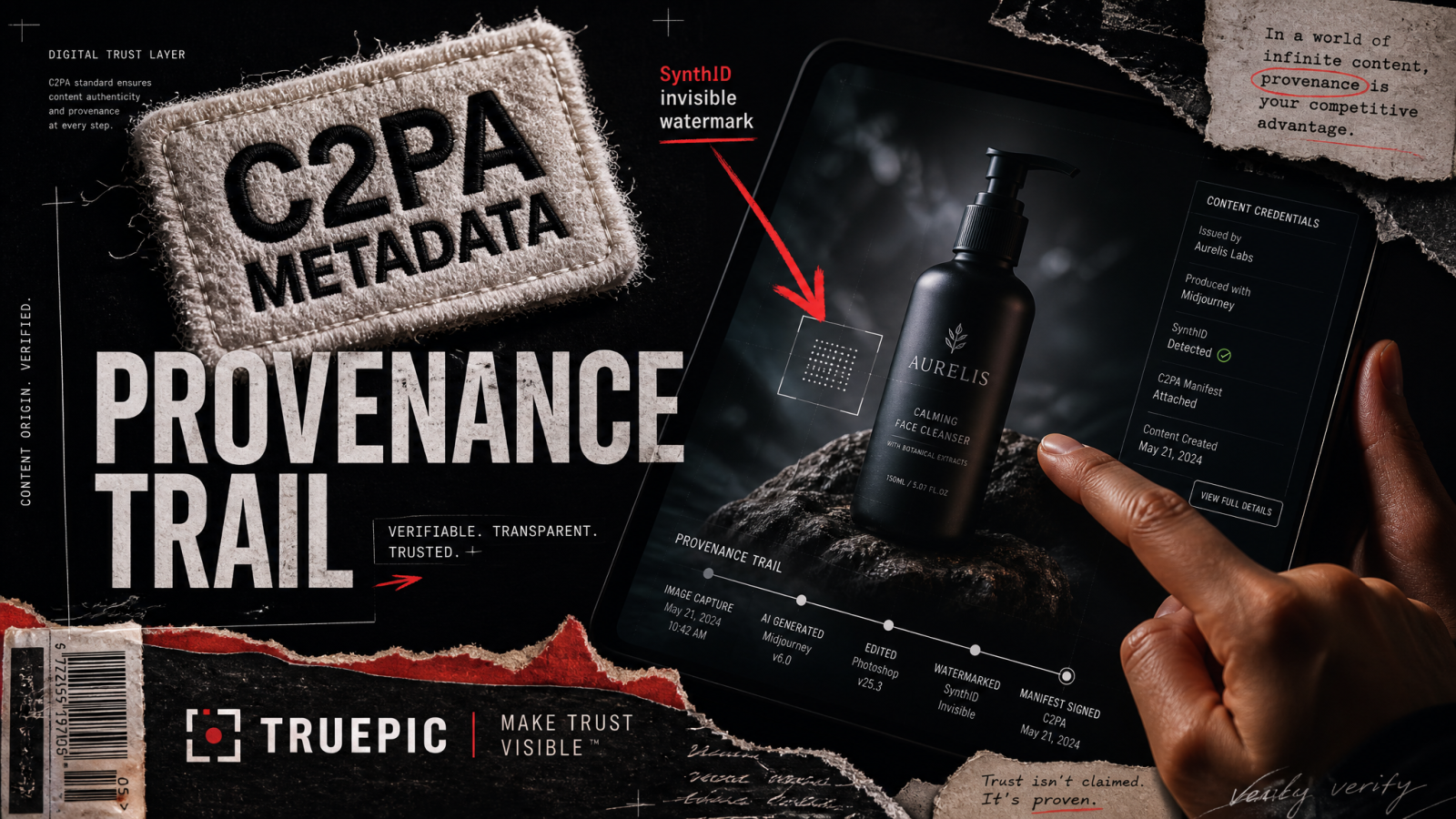
SynthID is Google DeepMind's watermarking family. Google describes it as embedding an imperceptible signal into AI-generated images, audio, text, and video. The point of a watermark over metadata is durability: the two systems reinforce each other, since a watermark can survive screenshots and transformations while metadata carries richer context. Google says the watermark survives cropping, filters, frame-rate changes, and compression without visibly degrading the file, and for audio it stays inaudible through MP3 compression and speed changes. Google is careful to add that SynthID isn't foolproof against extreme image manipulations — it's a strong signal, not an unbreakable one.
C2PA Content Credentials: the metadata trail
C2PA is the open standard from the Coalition for Content Provenance and Authenticity. Content Credentials are cryptographically signed metadata manifests embedded inside image, video, and PDF files that can record the capture device, the software used, and edits made. The catch: metadata is fragile. C2PA is vulnerable to metadata removal, which is exactly why watermarking exists as a backup. That's also why adoption is converging on a dual approach, with major providers now pairing SynthID watermarks alongside C2PA manifests.
What this looks like inside Google Search
The labeling shows up through Google's provenance features rather than a red flag on your ranking. The "About this image" feature that surfaces this metadata lives in Google Images and Google Lens, with verification rolling out across Circle to Search, and a user has to open a menu to see it. In other words, disclosure is informational. It documents media provenance and leaves rankings alone. Beyond Google, the credentials travel: Facebook, Instagram, LinkedIn, YouTube, and Google Images can read these credentials and show disclosure labels when AI content is detected.
Should you disclose AI-generated images?
Practically, disclosure is becoming the default, and it doesn't cost you rankings. Signing your assets with Content Credentials is a transparency move, not a self-inflicted penalty. The reasonable stance is to sign the assets you create or substantially edit, keep a human accountable for the page, and be honest where honesty matters, which is anything a reader would assume is a real photograph of a real thing.
There's also a business case beyond compliance. Provenance builds trust with an audience that's increasingly wary of fakes, and it protects you if a competitor or a fact-checker questions an image. Signing assets is cheap insurance for your credibility.
Some nuance is worth knowing. Human-facing labels rely on the perception of the recipient, so people tune them out once they're everywhere. And platforms often strip metadata on upload, which is why the watermark layer matters. None of that changes your SEO. It changes how much you can rely on any single signal to prove origin.
AI image SEO: the checklist that actually moves rankings
Since the production method is neutral, ranking comes down to the same image SEO fundamentals that have always worked. Google's own image best practices still apply to AI renders one for one.
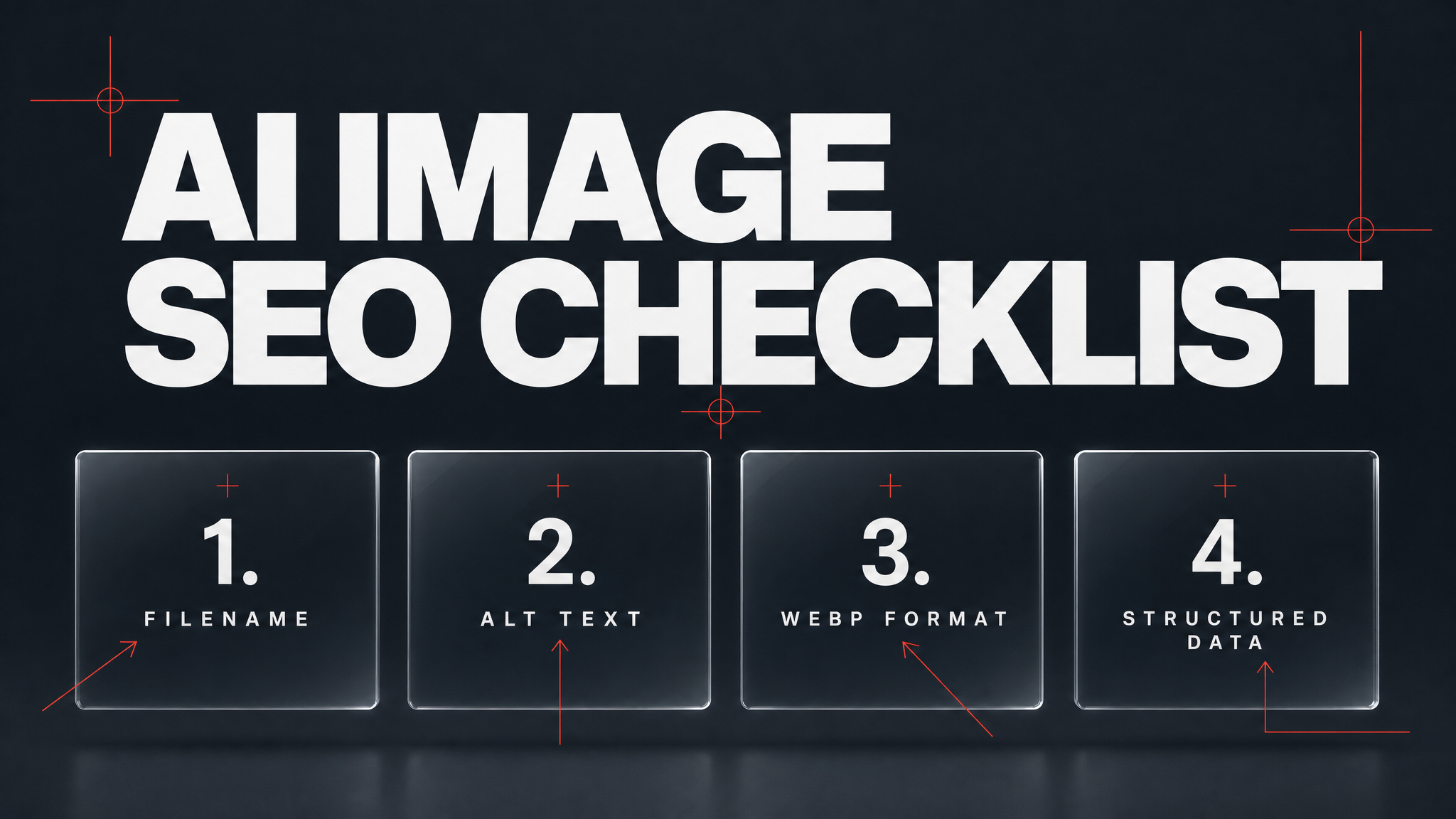
Use short, descriptive filenames like rosetta-latte-art.jpg, not IMG_01.jpg, with hyphens between words.
Write accurate alt text that describes what's in the image and its purpose on the page. Write for a person using a screen reader first, and relevance follows.
Export in modern formats. WebP or AVIF keeps pages fast, which protects the resource concern Google flagged.
Add structured data and image sitemaps so Google can discover and feature your images. Include the image in your sitemap and relevant schema.
Give every image context on the page. Images rank more consistently when the surrounding text genuinely relates to them. Put your AI visuals where they earn their spot.
If your renders come out soft or low-resolution, clean them before publishing. An image upscaler sharpens detail so a generated visual holds up at full size, and a background remover lets you drop a clean subject onto a page without a messy cutout. Sharp, relevant, fast-loading images are the signal Google rewards, whoever or whatever made them.
Why the "AI penalty" myth won't die
Every few weeks a headline claims Google is cracking down on AI. The claim keeps getting repeated because it's half-true in a way that's easy to misread. Google did roll out updates that de-ranked heaps of low-value pages, and a lot of those pages happened to be AI-spun. People saw the correlation and assumed causation.
The data says otherwise. The Ahrefs study of 600,000 top-ranking pages found that 86.5% contained some AI-generated content — only 13.5% were purely human-written — and the correlation between AI content percentage and ranking position was 0.011, effectively zero. AI content isn't systematically penalized. What got hit was thin, unedited, value-free output produced at scale. The same logic applies to images: a page full of generic, mismatched renders looks like low effort, and low effort is what loses.
Google's public position has been consistent since 2023. Danny Sullivan summed it up plainly: the company focuses on the quality of content, not how it's produced. That hasn't changed. So when you read that AI images will "get you deindexed," check whether the source is describing a quality problem dressed up as an AI problem. It usually is.
A practical workflow for publishing AI images safely
Here's the routine we'd recommend to a small team shipping visual content every week. None of it is exotic. It's just the discipline that separates useful images from filler.
Generate for the page, not the folder. Start from what the reader needs to see. A comparison table needs a labeled diagram, not a decorative render. Match the image to the intent of the section.
Clean and size before upload. Upscale soft outputs, cut distracting backgrounds, and export in WebP or AVIF. This protects load speed, the one concrete concern Google raised about heavy AI images.
Name and describe every file. Rename to a short, human-readable filename and write alt text that a screen reader user would find genuinely useful.
Keep the credentials. Leave SynthID watermarks and C2PA manifests intact where your tools produce them, so provenance travels with the file.
Put a human in the loop. Someone reviews the page, checks the images actually help, and takes accountability. That's the E-E-A-T signal Google cares about.
This scales. A seller building out a catalog, a marketer producing social creative, or a founder refreshing a brand page can run dozens of assets through the same steps. The tools change, the discipline doesn't. If you're producing video assets too, the same relevance-and-metadata thinking applies to an image to video workflow, where a still becomes a short clip for social.
For businesses publishing AI-generated visuals at scale, professional SEO Services can help ensure those images are supported by a technically sound, search-friendly website and content strategy.
AI images and AI-search visibility
The bigger shift is happening in how AI search surfaces content, and penalties have nothing to do with it. Answer engines and AI Overviews favor pages that are specific, well-structured, and trustworthy. Your images play a supporting role: they should match the claim on the page, carry honest metadata, and load fast enough to keep the page healthy. Provenance data can even help here, since machine-readable credentials give an engine more confidence about what it's looking at.
What this means for image search traffic
Google Image Search is still a real traffic source, and AI images compete there on the same terms as any other. Illyes even pointed out that relevant images can earn you traffic from image and video search. To win those clicks, the image has to answer a visual query: a labeled how-to step, a clear product on a clean background, a chart that explains a number. Decorative renders rarely rank in image search because nobody searches for decoration. Aim your AI visuals at questions people actually type into the image tab.
For teams shipping visual content at volume, the workflow matters more than the origin. A retailer generating catalog shots with a product photo generator and skipping the $400 studio session should still write real alt text, keep files light, and sign the assets. A founder building a brand with professional headshots instead of booking a photographer gets the same treatment. The risk lives in thin, mismatched, or manipulative use, never in the images themselves.
The bottom line
Google won't dock your rankings for using AI-generated images. It will dock you for low-quality, manipulative, or irrelevant content, exactly as it always has. Treat AI images like any other asset: make them relevant, name and describe them properly, keep them fast, and disclose their origin with SynthID or C2PA when it counts. Do that, and AI images are a speed advantage, not a liability.