
Gemini 3.8 Flash is Google's newest fast-tier AI model, released on September 2, 2026 alongside a specialized sibling called Gemini 3.8 Flash Cyber, built for cybersecurity defenders. Google detailed both models in a post on the official Google blog, framing the new release as an upgrade for coding and autonomous agent work, with the Cyber variant aimed at finding and patching software vulnerabilities. The launch lands just three weeks after Gemini 3.7 Flash, making it Google's third Flash-tier model in about six weeks, according to VentureBeat.
What is Gemini 3.8 Flash?
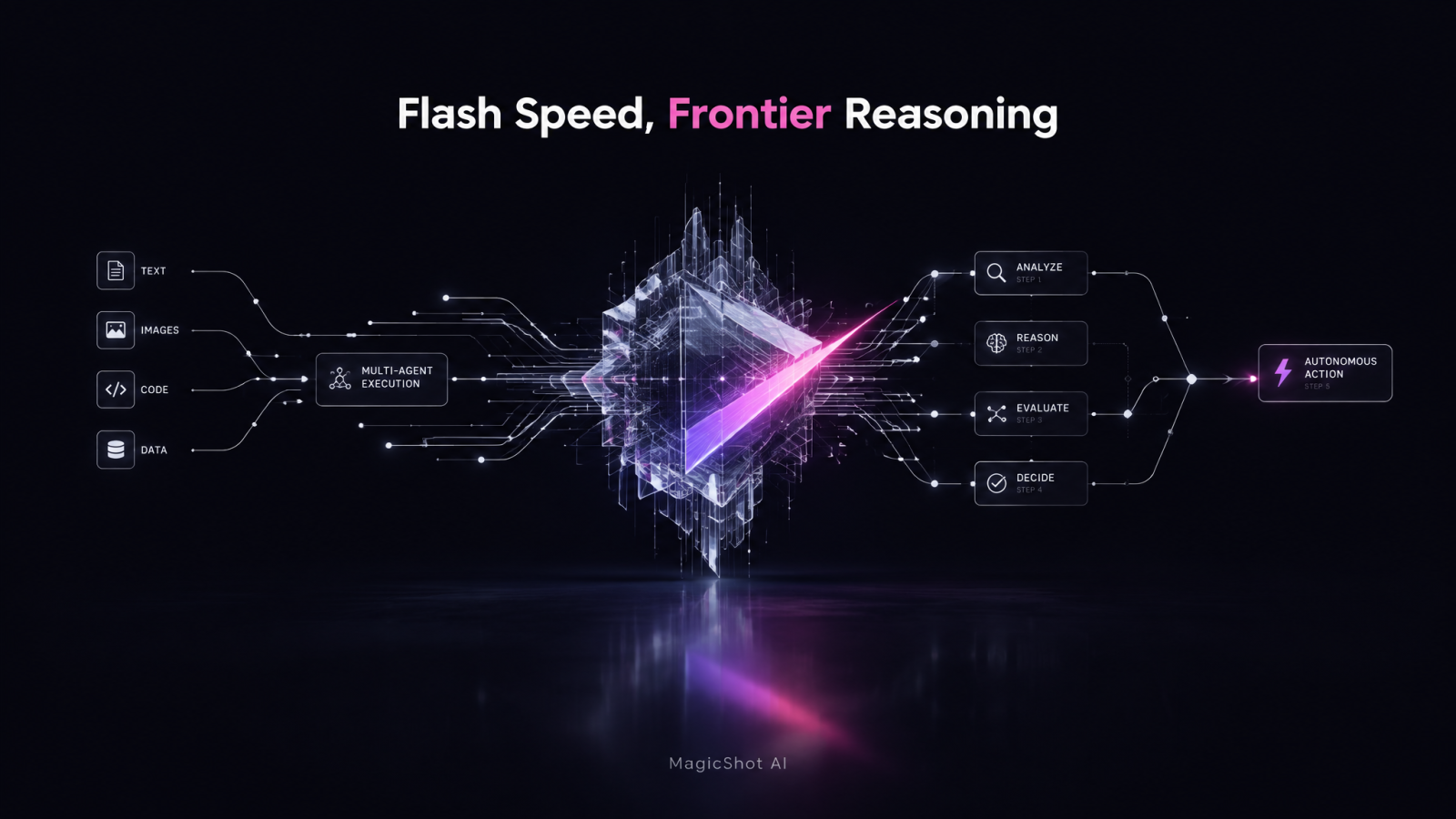
Gemini 3.8 Flash is a general-purpose model that Google positions as its fastest option for coding and agentic tasks, the kind of multi-step work where a model has to plan, use tools, and follow through without much hand-holding. Google's announcement, co-authored by Senior Director of Product Management Tulsee Doshi and Google DeepMind Gemini Security Lead Raluca Ada Popa according to explainx.ai's tracking of the post, calls it the company's best reasoning and coding model at Flash-tier speed and cost. That framing is echoed by Vellum AI, which noted the September 2, 2026 release made this the third Flash model in six weeks, following 3.6 Flash in July and 3.7 Flash in August.
The new version keeps the same 1 million token context window and pricing structure as its predecessor. It costs $0.75 per million input tokens and $3.75 per million output tokens through the end of 2026, after which the rate rises to $1.50 and $7.50 respectively, a detail confirmed by DataCamp's review of Google's developer documentation. That matches what 3.7 Flash charges today, so Google is betting on better output per dollar, rather than a price cut, as the selling point this round.
Benchmark gains, and where they land
Google published a table of agentic and reasoning benchmarks showing gains across coding, finance, and legal-style tasks. On Terminal-Bench 2.1, a test that measures how reliably a model finishes real command-line and coding jobs from start to finish, the new model scored higher than its predecessor, according to DataCamp. Coverage from 9to5Google reported that in quantitative and professional fields requiring advanced analysis and reporting, Google's release outperforms 3.7 Flash and other frontier models on benchmarks including Vals Finance Agent V2 and Harvey's Legal Agent Benchmark. Not every metric moved. Humanity's Last Exam, a broad knowledge and reasoning test, stayed roughly flat between the two versions per DataCamp's read of the numbers, a reminder that a newer release doesn't guarantee uniform gains everywhere.
On LMArena's community leaderboard, VentureBeat reported that the model ranks near the top of the Text Arena category, ahead of Claude Opus 5 and its own predecessor, with the clearest improvements showing up in multi-turn conversations, writing, instruction following, and coding tasks. That kind of crowd-voted ranking is a different signal from Google's own benchmark table, since it reflects people comparing model outputs side by side rather than a fixed test suite, and it's one reason outside outlets keep an eye on LMArena alongside vendor-published numbers.
Google is rolling the model out broadly. Consumers can reach it through the Gemini app, AI Mode in Search, and Google Sheets if they're on a Google AI Pro or Ultra subscription, while developers can call it through the Gemini API in Google AI Studio, Google Antigravity, Android Studio, or Vertex AI, and it's also live in Gemini Enterprise, according to VentureBeat's reporting on the launch. Google said 3.7 Flash remains fully supported for teams that prioritize lower token overhead over the newer model's gains, so nobody is forced onto the latest version on day one. That kind of parallel support is becoming standard practice as Google's Flash line ships on a near-monthly cadence rather than replacing the previous version outright.
Gemini 3.8 Flash Cyber: a specialist built for defenders
Gemini 3.8 Flash Cyber is a separate, security-tuned model that Google is not opening up to the public. It replaces the earlier 3.5 Flash Cyber and ships instead to a limited group of vetted users through a new access program Google calls Fairwind, aimed at governments, critical-infrastructure operators, and other trusted defenders, as reported by Thurrott. Google's own model page describes the Fairwind Program as a way to give trusted partners a head start against AI-driven cyber threats while keeping deployment controlled.
The headline figure Google is pushing is speed against real bugs. Google's blog post states that its Cloud Vulnerability Research team used the Cyber model to find a critical foundational vulnerability in under two hours, work that normally takes months of manual research. VentureBeat's coverage adds a specific example: one bug the model surfaced had sat undetected in Chromium and Chrome for 13 years, described as a subtle issue that dozens of engineers had reviewed without flagging. On CyberGym, which Google calls the standard industry benchmark for autonomous vulnerability discovery, Google says the Cyber variant shows frontier-level performance, per its own documentation on Google DeepMind's site.
Other figures circulating around the launch include a claim that the model tops 70% on internal vulnerability discovery tests across 20 programming languages and that Chrome's security team measured it producing 2.6 times more correct patches to Chrome vulnerabilities than the best commercial models available, a statistic reported by both Thurrott and VentureBeat in their launch coverage. Google's model documentation also cites a 47.2% pass rate on CWE-Bench, a benchmark built around the Common Weakness Enumeration catalog used across the security industry. Those results are notable, but worth reading with the access restriction in mind: unlike the general-purpose release, this variant isn't something a developer can sign up and test on their own account today. Google frames it as a defensive tool meant to stay ahead of attackers who are also experimenting with AI for vulnerability research, rather than a product built for wide developer adoption.
Why Google keeps shipping Flash models every few weeks
The pace itself is becoming part of the story. Gemini 3.6 Flash shipped July 21, 2026, Gemini 3.7 Flash followed on August 13, and now the newest release arrived September 2, a cadence Vellum AI pegged at roughly six weeks between releases. That's a tighter release rhythm than Google's flagship Pro-tier models typically get, and it lines up with how the company introduced Gemini 3.5 Flash as the default model at Google I/O back in May, a move that set the Flash tier up as the workhorse for everyday use rather than a stripped-down budget option.
Keeping pricing flat while pushing benchmarks up each cycle is a specific strategy: it lets Google argue that developers get more capability for the same monthly bill, rather than asking them to weigh a price increase against a capability increase. Whether that argument holds depends on the workload. Coverage from coding-focused outlets has pointed out that some of the model's gains come from spending more on "thinking" tokens behind the scenes, which can offset the headline price parity for certain tasks even though the sticker price hasn't moved. It's a pattern worth watching as Google, OpenAI, and Anthropic all trade releases roughly every few weeks now, each one claiming benchmark wins that only tell part of the cost story.
What this means for people working with AI image and video tools
Gemini 3.8 Flash and its Cyber sibling are language and coding models, not image or video generators, so nothing here changes what any AI photo or video tool can produce today. The more relevant signal is the pattern: Google is treating its fast, affordable Flash tier as the place where frontier gains show up first, and that same tier increasingly powers the agentic features, coding assistants, and backend infrastructure behind consumer-facing creative tools. Faster, cheaper reasoning models tend to filter down into smoother workflows and quicker turnaround, even when the visible product is a photo editor or a video generator rather than a chat window.
For creators, the practical takeaway is less about this specific release and more about the direction of travel: model providers are optimizing for speed and cost at the same time as capability, which is exactly what makes tools like text-to-video generators and background removers faster and more affordable to run at scale. MagicShot doesn't build on or rely on Gemini 3.8 Flash, but the broader trend of frontier labs shipping faster iterations more often is good news for anyone who depends on AI image, video, and voice tools to keep pace with client deadlines. It's also a reminder that the model doing the heavy lifting behind any creative tool changes often, sometimes every few weeks, even when the interface a creator sees stays the same.
Frequently asked questions
When was Gemini 3.8 Flash released?
Google released Gemini 3.8 Flash on September 2, 2026, according to Google's official announcement and reporting from Vellum AI. It arrived roughly three weeks after Gemini 3.7 Flash and about six weeks after Gemini 3.6 Flash, making it Google's third Flash-tier release in that span.
What is Gemini 3.8 Flash Cyber used for?
Gemini 3.8 Flash Cyber is a specialized version built for cybersecurity work, specifically autonomous vulnerability discovery and patch generation. Google restricts access to trusted defenders, including governments and critical-infrastructure operators, through its new Fairwind Program rather than offering it through the public API.
How much does Gemini 3.8 Flash cost?
Gemini 3.8 Flash is priced at $0.75 per million input tokens and $3.75 per million output tokens through the end of 2026, matching the introductory pricing of Gemini 3.7 Flash. After that window closes, the rate rises to $1.50 per million input tokens and $7.50 per million output tokens, per Google's developer pricing documentation.
Is Gemini 3.8 Flash Cyber publicly available?
No. Unlike the general-purpose release, the Cyber variant is limited to vetted participants in Google's Fairwind Program. Google describes this group as trusted defenders such as government agencies and critical-infrastructure operators, not developers signing up through the standard Gemini API.
How is Gemini 3.8 Flash different from Gemini 3.7 Flash?
Gemini 3.8 Flash keeps the same context window and pricing as 3.7 Flash but scores higher on coding and agentic benchmarks such as Terminal-Bench 2.1, Vals Finance Agent V2, and Harvey's Legal Agent Benchmark, according to reporting from DataCamp and 9to5Google. Gains are uneven, with broader knowledge benchmarks like Humanity's Last Exam staying roughly flat between the two versions.