
DeepSeek released DeepSeek-V4.1-Flash on September 10, 2026, and it is already reshaping the company's own lineup. The new model adds native image understanding, runs on a redesigned architecture DeepSeek calls Causal Encoder-Decoder, and, according to DeepSeek, outperforms the company's own V4-Pro flagship on speed, cost, and completion time.
Key takeaways
DeepSeek shipped DeepSeek-V4.1-Flash on September 10, 2026, calling it the smallest model in a new architecture family with native visual understanding.
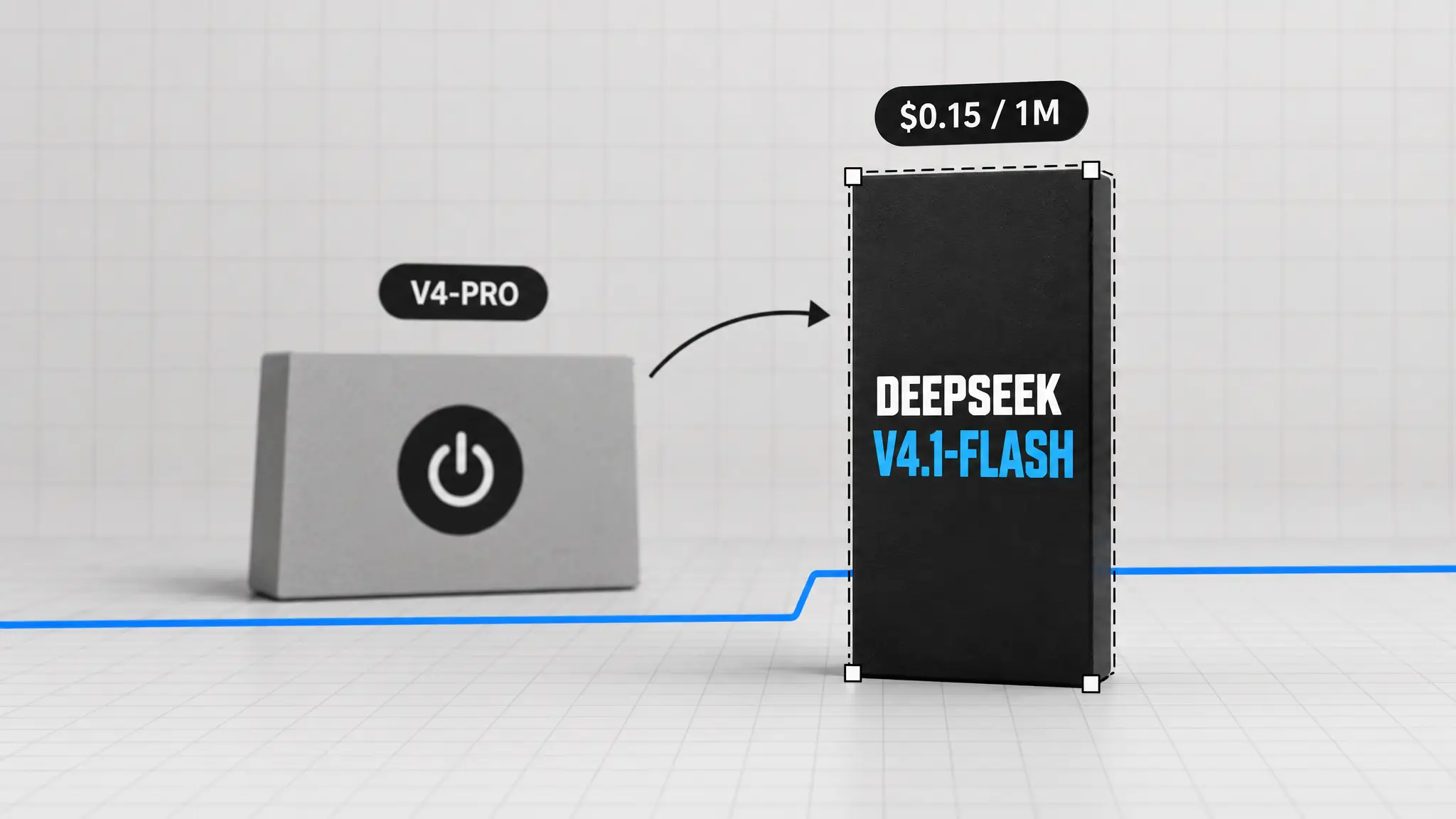
DeepSeek is retiring V4-Pro: starting at 04:00 UTC on September 14, 2026, all V4-Pro API requests route to V4.1-Flash and get billed at Flash-series rates.
Off-peak pricing runs $0.15 per million input tokens on a cache miss, $0.003 per million on a cache hit, and $0.60 per million output tokens, with peak hours priced at double that.
The model is a 552-billion-parameter mixture-of-experts system that activates only 8 billion parameters to read a prompt and 16 billion to write a reply, according to a technical breakdown from eesel AI.
Third-party model trackers including OpenRouter list a 1,048,576-token context window, positioning V4.1-Flash for long-document and agentic workloads rather than short chat replies.
What DeepSeek announced on September 10
DeepSeek's official announcement frames V4.1-Flash as more than an incremental update. The company introduced the smallest model in its new architecture family, designed for greater capability, faster inference, and higher throughput. DeepSeek is explicitly building a family around this architecture, with V4.1-Flash as the entry point rather than a one-off release.
Reporting from TechNode confirms the release date and adds a detail worth noting: DeepSeek said that V4.1 Flash had surpassed V4 Pro in performance, cost, speed and total completion time in internal and external testing, according to a notification the company sent to API users. That's unusual. Most model makers position a "Flash" or "mini" tier as a cheaper, slightly weaker alternative to a flagship. DeepSeek is instead saying the smaller, cheaper model beats the bigger one outright.
DeepSeek is retiring V4-Pro in favor of Flash
The clearest sign of how confident DeepSeek is in this release: it's sunsetting the model V4.1-Flash replaces. Per DeepSeek's own notice, starting at 04:00 UTC on September 14, 2026, all deepseek-v4-pro requests will route to V4.1-Flash at V4.1-Flash rates, and that routing continues until V4.1-Pro ships. TechNode's coverage pins the cutover in local terms too, noting that starting Sept. 14 at noon Beijing time, requests to V4 Pro will be routed to V4.1 Flash and billed at Flash-series rates.
For developers with V4-Pro already wired into an app, this is effectively a forced, no-code upgrade. The model ID keeps working, but every request after the cutover hits different weights and a different price sheet. DeepSeek frames it as a straight discount, saying V4.1-Flash lets it serve more users at lower cost and it's passing the savings along.
How the Causal Encoder-Decoder architecture works
The headline technical change is what DeepSeek calls Causal Encoder-Decoder, or CED. A detailed writeup from eesel AI explains the split: a 20-layer encoder reads your input using just 8 billion active parameters, then a 20-layer decoder writes the reply using 16 billion, out of a 552-billion-parameter total. Only a small slice of the model switches on for any given request, which is the mechanism behind the lower per-token price.
OpenRouter notes that image understanding is native to the architecture, with visual and text embeddings trained jointly from the start of pretraining rather than added afterward, unlike the earlier experimental V4-Flash-Vision model DeepSeek shipped as a preview. That distinction matters for teams that tried DeepSeek's earlier vision bolt-on and found it inconsistent: V4.1-Flash was built to see images from day one of training, not patched on later.
DeepSeek-V4.1-Flash pricing and the KV cache angle
DeepSeek's pricing leans heavily on cache-hit discounts. Off-peak, the company charges $0.15 per million input tokens on a cache miss, $0.003 per million on a cache hit, and $0.60 per million output tokens, figures confirmed independently by both eesel AI and OpenRouter. Peak hours, which DeepSeek and TechNode both define as 01:00 to 04:00 UTC and 06:00 to 10:00 UTC on weekdays, double those rates.
Coverage from Dataconomy puts that in perspective: at off-peak rates, V4.1-Flash totals $0.75 per 1 million tokens based on $0.15 input and $0.60 output pricing, a figure the outlet says trails only a handful of competing tiers on total cost. The reason cache-hit pricing gets so much attention is architectural: DeepSeek says the model's KV cache is compressed well below prior generations, and cache-hit charges can account for a large share of the total bill in agent and coding workloads that repeatedly reuse context. VentureBeat adds a useful caution here, noting that comparing models on uncached input price alone can obscure one of the fastest-growing components of agent economics.
Context window, benchmarks, and where it fits
DeepSeek is positioning V4.1-Flash as an agentic and coding tool, not just a chat model. OpenRouter's listing puts the context window at 1,048,576 tokens and describes the model as suited for coding, terminal, and computer-use agent work. Requesty's benchmark page cites a score of 88.1 on CyberGym, a coding-security benchmark, though as with any vendor-reported figure, it's worth treating as a data point rather than a definitive ranking until independent evaluations catch up.
DeepSeek's own post names early integration partners: official partners WorkBuddy, including CodeBuddy, and OpenCode now fully support V4.1-Flash, according to the company's announcement. TechNode separately reported that DeepSeek's own coding tool, Harness, shipped version 0.1.5 the same day with dedicated support for the new model, suggesting DeepSeek built this release around developer tooling rather than a consumer chat refresh.
What DeepSeek-V4.1-Flash means for creators using AI image and video tools
V4.1-Flash is a text and reasoning model with native vision input, not an image or video generator, so it won't directly compete with tools that create pictures or clips. But the release is still a useful signal for anyone building a content workflow around AI: prices for capable models keep falling, and vision is becoming a default feature rather than a paid add-on, even at the cheapest tier of a lineup.
The practical takeaway is less about this specific model and more about the direction of the market. As language models absorb image understanding by default, the tools that actually produce visuals, photos, product shots, headshots, video clips, still need to be purpose-built for that job. If you're already generating product photography with a tool like MagicShot's product photo generator or turning stills into motion with its image to video tool, a cheaper, vision-capable text model in the background doesn't change your workflow, but it does mean the cost of pairing AI text and AI visuals together keeps dropping.
Frequently asked questions
What is DeepSeek-V4.1-Flash?
DeepSeek-V4.1-Flash is a 552-billion-parameter mixture-of-experts model that DeepSeek released on September 10, 2026. It is the first model built on the company's Causal Encoder-Decoder architecture and the first Flash-tier model with native image understanding trained in from the start.
Is DeepSeek-V4.1-Flash cheaper than V4-Pro?
Yes. DeepSeek said V4.1-Flash beat V4-Pro on performance, cost, speed and completion time in its own testing, and starting September 14, 2026, all V4-Pro API requests route to V4.1-Flash and are billed at Flash-series rates.
How much does DeepSeek-V4.1-Flash cost per token?
Off-peak, DeepSeek prices it at $0.15 per million input tokens on a cache miss, $0.003 per million on a cache hit, and $0.60 per million output tokens, with peak-hour rates set at double those figures.
What is the Causal Encoder-Decoder architecture?
It's DeepSeek's new design that splits reading and writing into separate stages: a 20-layer encoder processes the input using 8 billion active parameters, then a 20-layer decoder generates the reply using 16 billion, so only a fraction of the 552-billion-parameter model runs at once.
Does DeepSeek-V4.1-Flash support images?
Yes. It has native multimodal visual understanding built in during pretraining rather than added afterward, making it the first Flash-series model in this generation to handle image inputs alongside text.