
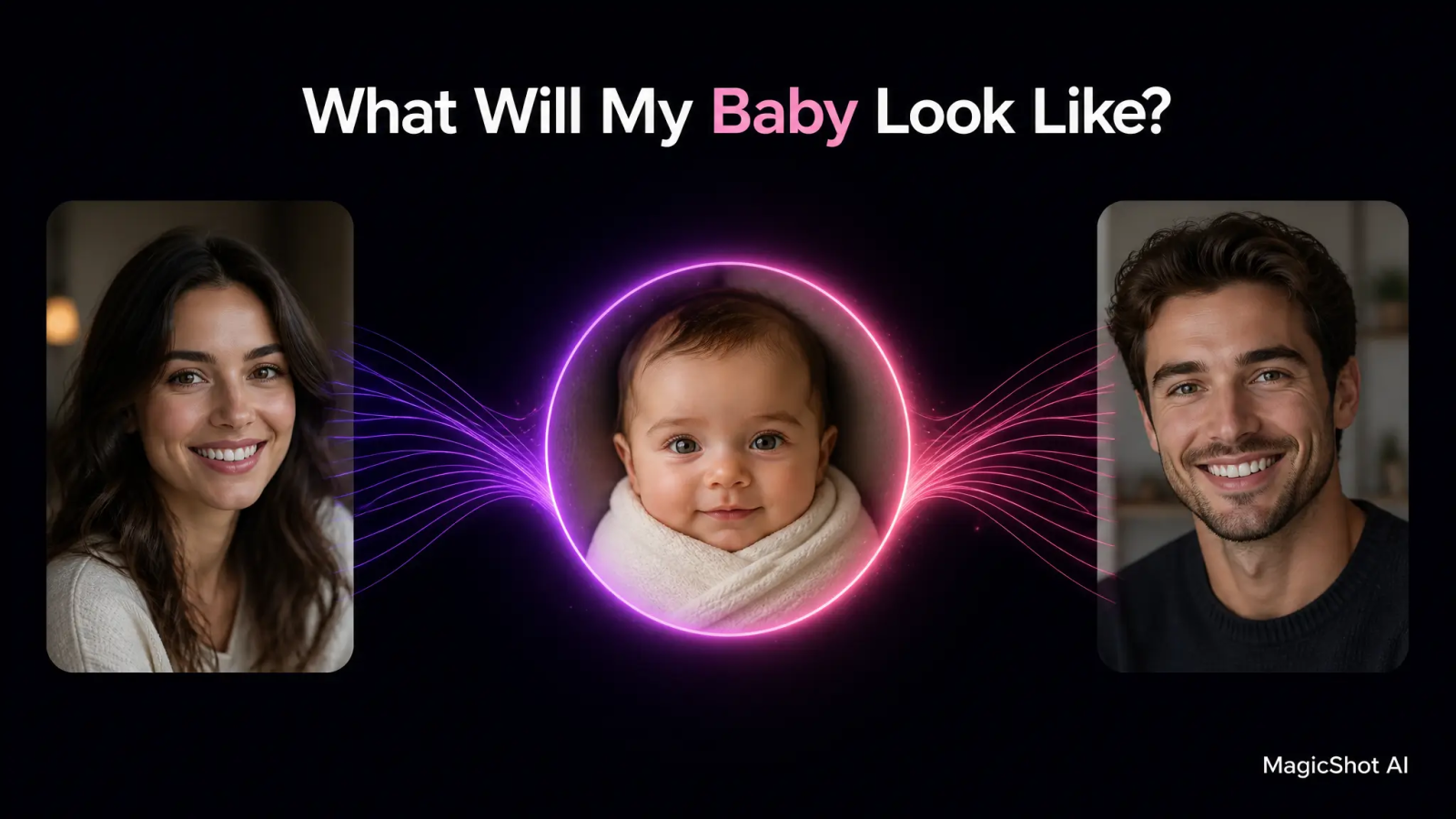
Every future parent eventually googles it at some odd hour: what will my baby look like? Usually right after a friend posts an ultrasound, or after an argument about whose nose is "dominant." The honest answer is nobody knows for certain until the kid actually shows up. But an AI baby generator can give you a plausible, photo-realistic preview by blending both parents' faces and applying real facial patterns, not just fading two photos together in an old editing app.
MagicShot's AI baby generator works from two uploaded photos, maps the features that actually get passed down, and hands back a baby face in about a minute. If you want to jump straight in, you can try the AI baby generator here and see a few style and gender options before you commit to one.
What Will My Baby Look Like? The Short, Honest Answer
Genetics doesn't work like mixing paint. A baby can inherit a grandparent's eye shape, a parent's chin, and a completely unrelated relative's hair texture, all in one face. So no tool, human or AI, can hand you a guaranteed photo of your future child. What a good AI baby generator can do is give you a realistic, statistically reasonable guess based on the two faces you feed it, the same way a police sketch artist works from witness features rather than a photograph.
That distinction matters. If a site promises a "100% accurate" prediction, be skeptical. The value of ai baby photos isn't scientific certainty, it's a fun, shareable, decently convincing preview that helps you picture the next few years before they arrive.
How AI Baby Generators Work: Face Blending, Genes, and Age
Under the hood, most baby face generator tools follow a similar pipeline. First, the model detects facial landmarks on both parent photos, things like eye spacing, nose bridge width, jaw shape, and skin tone. Then it runs a form of child face prediction, weighting features based on how commonly they're inherited (eye color and skin tone tend to blend, while strong traits like deep-set eyes or a distinct chin often show up clearly in one parent and carry through).
From there, the generator reconstructs a new, original face rather than pasting parts from either photo, which is why the result looks like an actual kid instead of a collage. Better tools also let you choose an age stage, newborn, toddler, or young child, since a six-month-old and a six-year-old version of the same predicted face can look surprisingly different. If you're curious how far that aging concept goes, MagicShot's Age Journey tool applies the same kind of face-aging logic all the way into adulthood.
What Heredity Cues Actually Get Used
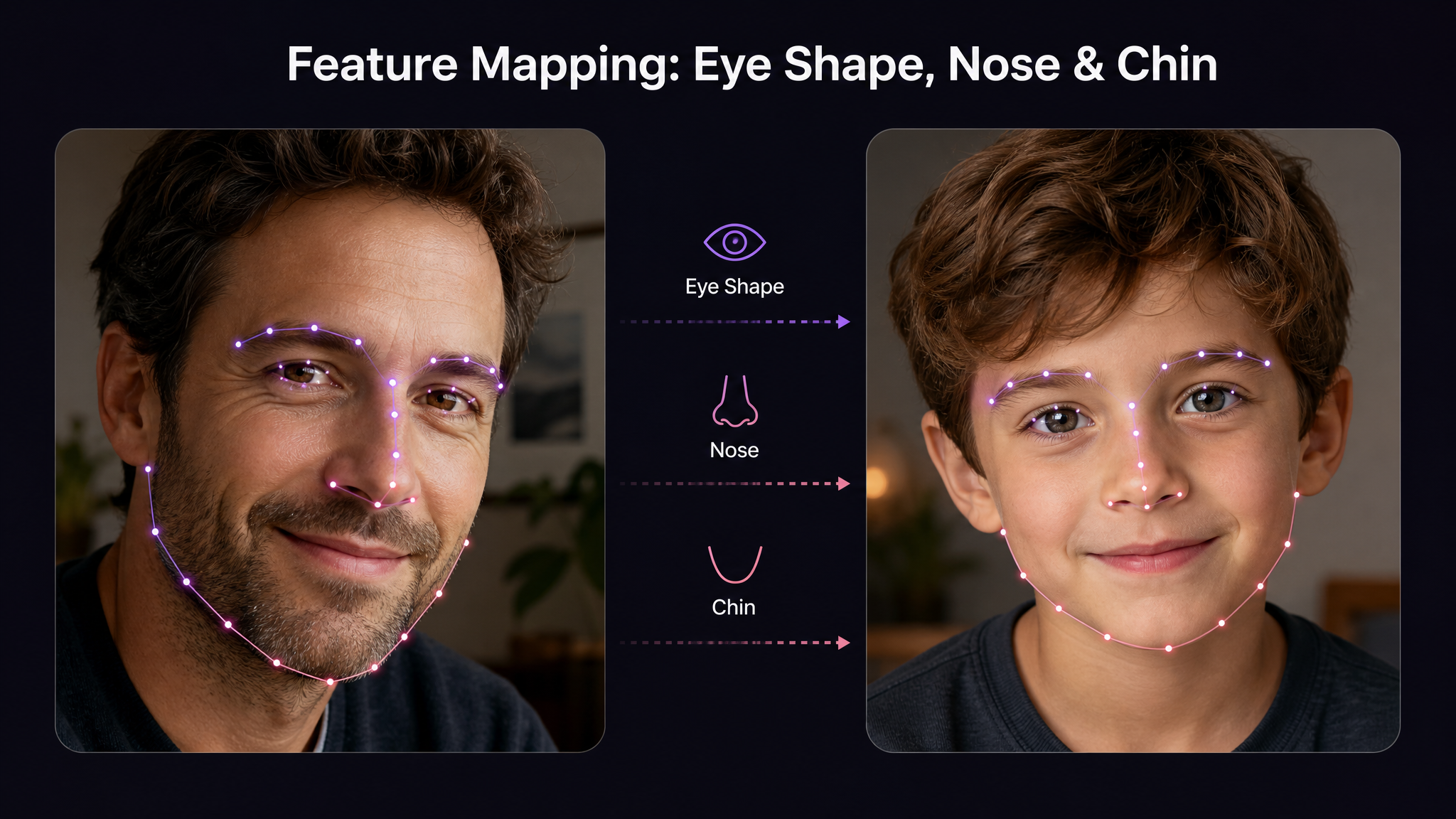
Skin tone: usually blends between both parents rather than favoring one.
Eye shape and color: can lean heavily toward either parent, so the AI weighs both possibilities.
Nose and chin structure: often the most "inheritable-looking" features in a generated result.
Hair texture and color: harder to predict accurately, so most generators treat this as a lighter blend.
Baby Photo Generator or Baby Face Generator, Same Thing?
People use "baby photo generator" and "baby face generator" interchangeably, and honestly, they are the same category of tool. Both describe software that turns two parent photos into one predicted child image. The wording difference usually just comes down to how someone phrased their search, not a real feature gap. What actually varies between tools is the quality of the ai babies they produce, how many age and gender variations you get, and whether the final image looks like a real photo or an obvious digital composite.
What Will Our Kids Look Like at Different Ages?
"What will our kids look like" is really two questions: what will the baby look like on day one, and what will that same face look like once it's running around at age five? A newborn's features are still settling, soft, rounder, less defined, while a toddler face starts showing the jawline and eye shape that will stick around longer. A solid AI baby generator gives you both options instead of locking you into one static "baby" result. It's a small feature, but it's the difference between a cute novelty image and something that actually feels like a preview of your family in a few years.
What Makes the Best AI Baby Generator
Baby maker apps, which is just another name people search for AI baby generators, all promise roughly the same thing. The differences show up in the details. When judging the best ai baby generator for your situation, look at:
Photo quality of the output. A blurry, low-res result isn't worth sharing. Look for tools that render a clean, print-worthy image, not a pixelated guess.
Gender preview options. Being able to generate an ai baby girl version alongside a boy version, instead of guessing one and being stuck with it, gives you more to compare.
Age range. Newborn-only tools are limited. An ai toddler option adds real value for anyone who wants to picture the "walking and talking" stage, not just the hospital photo.
What else is included. Most people who try a baby generator once end up wanting a matching family photoshoot, a headshot refresh, or a fun avatar later. A single plan covering 500+ AI models beats juggling five separate subscriptions for five separate one-off images.
That last point is worth sitting with. A lot of "baby predictor" sites charge per image and disappear the moment you close the tab. MagicShot bundles the baby generator with the rest of its photo and video tools under one plan, so the same account that made your baby preview can also handle a Baby Photoshoot once the real thing arrives.
How to Get Realistic AI Baby Photos From Your Pictures
The output is only as good as what you feed it. Before you upload, a few habits noticeably improve results:
Use a front-facing, well-lit photo. Side angles and heavy shadows confuse landmark detection.
Skip sunglasses, hats, and heavy filters. The AI needs to see your actual eyes, brows, and hairline.
Pick a neutral or lightly smiling expression. Exaggerated expressions can distort proportions in the final blend.
Use one face per photo. Group shots make it harder for the model to isolate the right features.
Start with a sharp source image. If your best photo of yourself is a bit blurry or old, running it through Face Enhancer first can clean it up before it goes into the baby generator.
None of this is complicated, it's the same advice a passport photo booth would give you. But it's the difference between a face that looks like a plausible child and one that looks like two photos awkwardly melted together.
See What Your Baby Will Look Like: Fun Extras
Once you've got a straightforward prediction, most people start playing. A celebrity baby generator swaps one parent's photo for a celebrity's, mostly for laughs rather than accuracy, since the AI still treats the celebrity face the same way it treats any uploaded photo. Some baby maker apps also pair the image with an AI baby name generator, suggesting names that supposedly match the predicted face or vibe, though take that particular feature as entertainment rather than science.
People also search for an odds of having twins calculator when they're deep in the "what if" spiral. Worth being clear here: an AI baby generator predicts what a face might look like, it doesn't calculate the actual odds of having twins, which depend on family history, maternal age, and fertility factors rather than anything a photo blending tool can measure. If twins run in your family and you're curious what two kids might look like, the simplest approach is generating two separate baby previews and comparing them side by side.
Getting the Most Out of Your Preview
Treat the result for what it is: a fun, reasonably informed guess, not a medical prediction. Save both the baby and toddler versions if the tool offers them, since seeing the same predicted face age a few years is usually more interesting than a single static image. And if you're doing this as a couple, generate a few gender and age combinations before picking a favorite. It costs you a couple of minutes, and it beats settling on the first result out of impatience.
Ready to see it for yourself instead of just reading about it? Generate your AI baby photo now and preview the options before deciding which one you want to keep.