
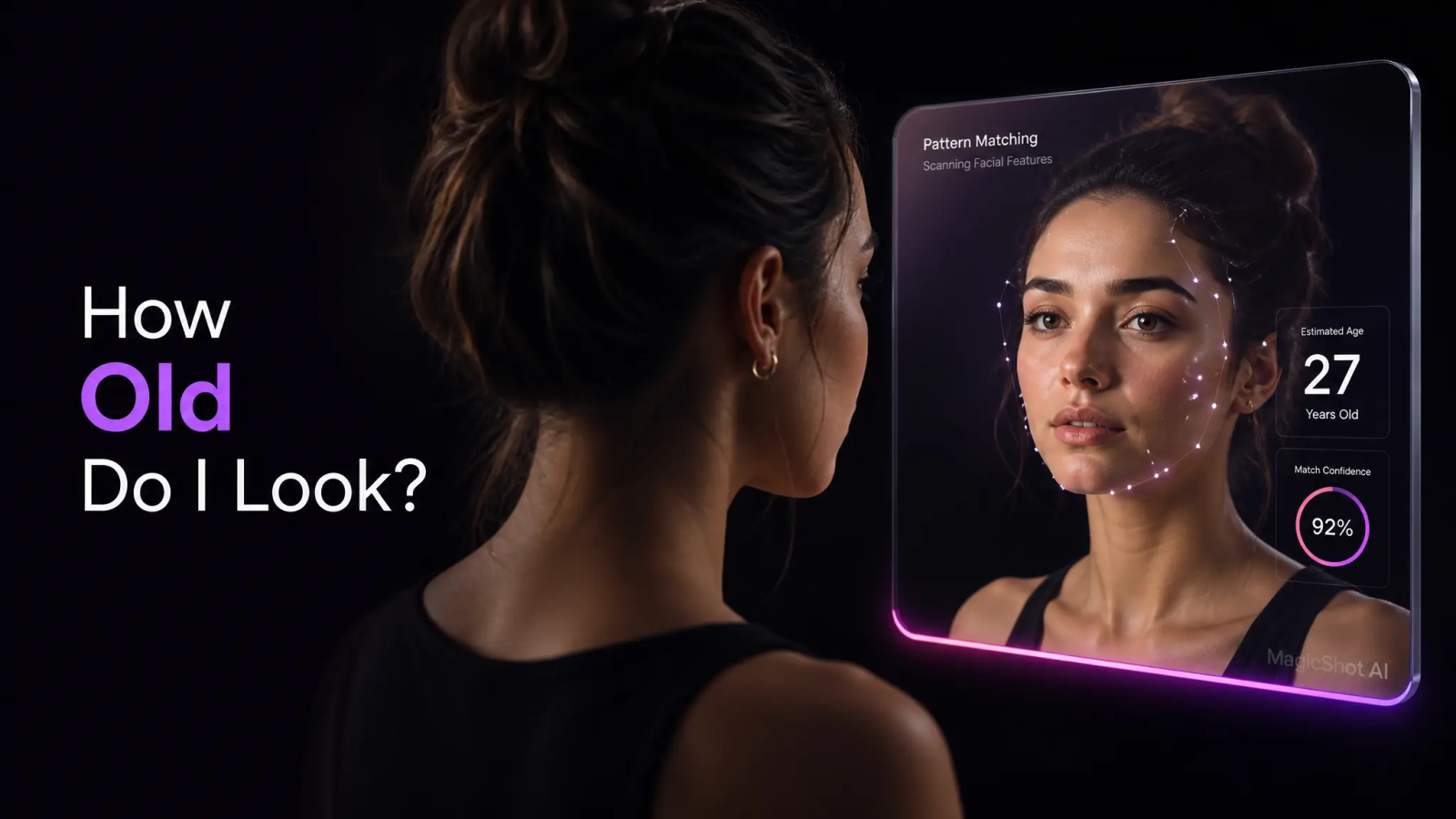
Type "how old do I look" into a search bar and you already know the real question underneath it: does your face match your birth certificate, or is it telling a different story? Maybe a barista just carded you at 34. Maybe your cousin swears you look ten years younger than your driver's license says. Either way, curiosity plus a decent photo is reason enough to run the test. MagicShot's Age Predictor gives you a direct answer from a single photo, no waiting room, no dermatologist visit, just a number based on what your face actually shows right now.
Before you upload anything, it helps to know what these tools are actually doing under the hood, why two age guessing apps can look at the same face and land on different numbers, and how to set up your photo so the read is as close to reality as possible.
How AI Guesses Your Age From a Photo
A face age guesser doesn't know your birthday. It's not pulling records or checking an ID. It's pattern-matching your face against millions of other faces with known ages, then estimating where you fall based on visible traits. Three categories of evidence do most of the work.
Skin texture is the biggest signal. The model looks at fine lines around the eyes and mouth, pore size and visibility, and how even or uneven your skin tone is across the cheeks and forehead. Smoother, more uniform texture reads younger; more visible texture reads older, regardless of your actual age.
Facial structure matters almost as much. Cheekbone position, jawline sharpness, the depth of the eye sockets, and how much volume sits in the mid-face all shift predictably as people age. A rounder, fuller face with a soft jawline tends to register as younger; a more angular face with hollowed cheeks tends to skew older.
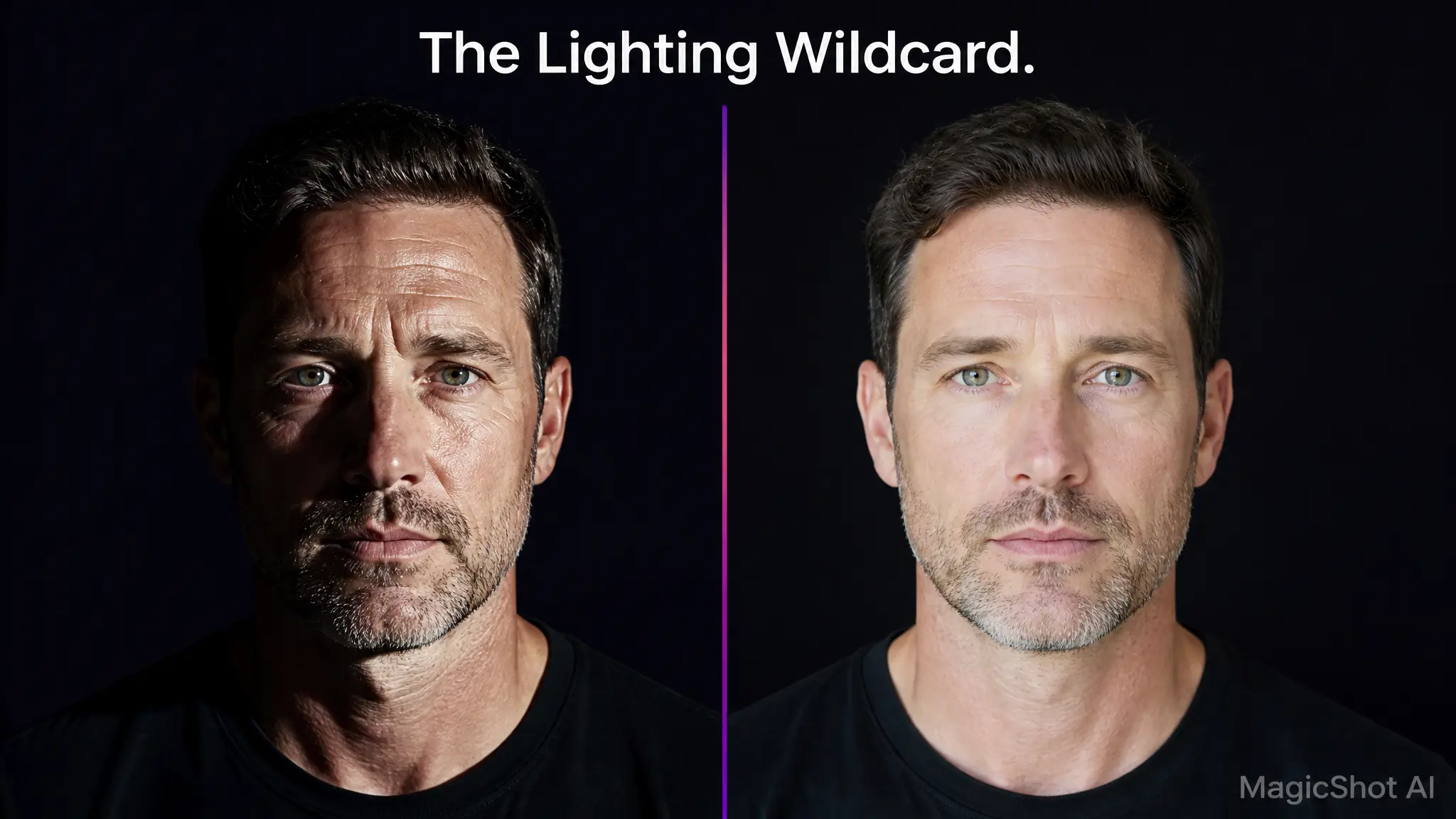
Lighting and image quality are the wildcard. Harsh side lighting throws shadows into every crease and can add years to an otherwise young face. Flat, bright, even lighting does the opposite: it smooths texture the same way a good ring light flatters anyone on a video call. This is exactly why the same person can get two different results from two different photos taken an hour apart.
What an Age by Photo Tool Actually Measures
An age by photo result is an estimate of your apparent age, not a medical or biological one. Apparent age is the age your face visually presents to a stranger or a camera, based purely on surface cues like skin, bone structure, hair, and expression. It has nothing to do with your actual birthdate, your health, or how you feel that day.
This distinction matters because people sometimes expect an age identifier to work like a lie detector for your DNA. It doesn't. Think of it more like asking a stranger to guess your age at a bus stop, except the stranger has looked at a few million faces and doesn't get distracted, tired, or polite. That's also why the result can shift with something as simple as a haircut, a tan, or a full night's sleep versus a rough one.
It's also worth separating this from an age calculator photo that works off a birthdate, like the kind used for retirement math or eligibility forms. Those tools do arithmetic. A face-based age tester does estimation. The math version is always exact; the face version is always a best guess dressed up as a clean number.
Why Every Age Guessing App Gives a Slightly Different Number
If you've run the same face through more than one age guessing app, you've probably noticed the numbers don't match exactly. That's normal, and it's not a sign that either tool is broken. A few things drive the variance:
Angle: A slight downward angle can soften a jawline and shave a few years off; a straight-on shot with harsh overhead light does the opposite.
Expression: A big smile creates lines around the eyes and mouth that a neutral expression doesn't show at all.
Resolution and compression: A blurry or heavily compressed photo hides fine texture detail, which can throw an age detector online off in either direction.
Makeup, filters, and grooming: Concealer, contour, beard trims, and even basic phone camera "beauty" filters all change the texture and contour signals the model is reading.
Even human guessers vary by five to ten years on the same face. An AI model trained on photo data will show some of that same natural spread, because apparent age was never meant to be a fixed, lab-measured number. If you want a sense of how much a single choice can move the number, upload the same photo twice, once as-is and once cropped slightly differently, and compare. The gap tells you more about how sensitive these reads are than any single result does.
How to Get an Accurate How Old Do I Look Test
If you want a how old do I look test that actually reflects your current face rather than your lighting setup, treat the photo the way you'd treat a passport photo, not a selfie for a dating app.
Use a recent photo. A shot from three summers ago won't tell you what age you look like today.
Face the camera directly. Straight-on, eye level, no tilted chin or dramatic angle.
Go for even, natural light. Daylight near a window beats overhead bulbs or a single hard flash every time.
Keep your expression neutral. A relaxed, closed-mouth expression gives the model a cleaner read than a wide grin.
Skip filters and heavy makeup. They're designed to hide the exact texture cues the model is trying to read.
If your only available photo is dim, blurry, or low resolution, don't try to compensate with a filter. Run it through Brighten Image to fix uneven lighting, or use the Image Upscaler to recover detail in a soft or low-resolution shot. Both clean up the technical quality of the photo without smoothing your skin or changing your features, which keeps the age read honest.
Guess My Age by Photo: Best Practices Before You Upload
A few habits separate a useless guess my age by photo attempt from a genuinely informative one. First, use one clear, unobstructed face per image. Group photos, sunglasses, hats pulled low, and hair covering the forehead all remove the exact data points the model needs. Second, crop reasonably close but don't cut off the chin or forehead. Both areas carry aging signals the model relies on.
People also use these tools for reasons beyond pure curiosity. It's a common party or group-chat game: everyone drops a photo and tries to guess how old I am before checking the actual result. It shows up in skincare routines too, as a rough before-and-after check every few months. And plenty of people run it just to see how old they look after a haircut, a new beard, or a summer tan. If you want to add a lighter, more playful spin to the exercise before or after testing your age, MagicShot's Fun Filters are worth a look, though they're built for entertainment, not for feeding into an age reading.
One more practical tip: if your face looks tired or uneven in the source photo because of blemishes, red patches, or under-eye shadows that aren't part of your normal skin, a quick pass through Face Enhancer can even out temporary skin issues so the result reflects your face on a normal day rather than a rough one.
How Old Do I Look App vs. Asking a Friend
Asking a friend "how old do you think I look" gets you one opinion, shaped by how well they know you, whether they're being polite, and how much attention they're actually paying. A how old do I look app skips the social filter. It doesn't know you, doesn't care about your feelings, and reads the same visual cues every time you feed it a photo. That consistency is the real advantage: it's not that the app is smarter than your friend, it's that it applies the same standard to every image instead of adjusting its answer based on the conversation.
That said, neither one is a substitute for the other. A friend can factor in context an app can't see, like the fact that you haven't slept in two days. An app can't read context at all, it only reads pixels. Use the app when you want a quick, judgment-free number. Use your friend when you want an honest opinion with some grace attached.
What Age Do I Look Like, and What Should You Do With That Number?
Once you have your result, the honest answer to "what age do I look" is whatever the model shows you, filtered through everything above about lighting, expression, and photo quality. It's a snapshot, not a verdict. If the number surprises you in either direction, try the test again with a different photo before drawing any conclusions about your skin or your habits.
If the exercise has you curious about the other direction, MagicShot's Age Journey tool is the natural next step. Instead of telling you how old you look right now, it shows you a realistic version of your face at a different age, older or younger, so you can see the arc rather than just one point on it. It's a good way to turn a one-off curiosity check into something you actually want to save and share.
Both tools, along with the rest of MagicShot's photo and video lineup, sit under a single plan that covers more than 500 AI models. That means the same account that ran your age test can also clean up a photo, generate product shots, or build a video, without juggling separate subscriptions for each job.
Curious what your face is telling people right now? Run your own how old do I look test on MagicShot's Age Predictor and get your number in the time it takes to upload a photo.