
Everybody asks the same thing at some point: what would our kid look like? A best free AI baby generator promises an answer in seconds, no ultrasound, no waiting nine months, no arguing over whose nose wins. But the results range from spookily convincing to comically off. So we did the boring, useful thing. We picked one couple, locked in two clear parent photos, and pushed them through six tools to see which predictions actually held up.
This is not a lab study. It's a hands-on test of what you get when you upload a photo and hit generate. We judged three things: how much the baby resembled a real blend of both parents, how clean the image looked, and how painless the process was start to finish. Below is exactly what we found, tool by tool, plus the practical stuff nobody tells you before you upload your face.
How we tested the best free AI baby generator tools
Consistency was the whole point. We used the same two front-facing photos for every run: even lighting, no sunglasses, no heavy filters, both faces looking straight at the camera. Bad inputs wreck every one of these tools, so we removed that variable up front and kept it identical across all six.
For each tool we scored three things on a simple 1 to 5 scale:
Resemblance: did the baby actually borrow features from both parents, or just spit out a generic cute infant?
Image quality: real skin texture and symmetry, or melty ears and a smudged background?
Ease and speed: how many steps, how long the wait, how many upsells before you see a result.
One thing worth saying early: no baby generator predicts a real future child. Genetics does not work like a face-blend slider. What these tools do is mix the visual features of two faces and render a plausible infant. Treat the output as entertainment, not a sonogram, and you'll enjoy it a lot more.
How accurate are AI baby generators, really?
Short answer: they are good at plausible, not at prophecy. The better tools genuinely pull traits from both parents, a father's jaw, a mother's eye shape, a shared skin tone, and combine them into a face that feels related. The weaker ones ignore one parent almost entirely or default to the same doe-eyed baby regardless of who you upload.
Across our six runs, resemblance was the hardest score to earn. Image quality has gotten cheap and common; almost every tool can render smooth skin now. Making a baby that looks like your two faces, not a stock infant, is where the tools separated. And accuracy in the scientific sense is zero, because eye color, hair, and height are decided by genes these models never see. So the honest framing is this: a good AI baby generator gives you a fun, believable "what if," and that's the right expectation to bring to it.
If you're using one to settle a debate about whose features will "win," relax. The tool is guessing from pixels, not chromosomes. Where it earns its keep is the surprise factor and the shareability, which is a real reason people love these, just not a scientific one.
The 6 AI baby generators we tested
1. The face-blend apps
A cluster of mobile apps do the classic morph: upload mom, upload dad, get a baby. Speed was their strength; most returned something in under a minute. Resemblance was the problem. Two of them handed back nearly the same baby for different couples, which tells you the "blend" is thinner than advertised. Watch for aggressive paywalls that hide the finished result behind a subscription after you've already uploaded your faces. That pattern showed up more than once here.
2. The web-based predictors
Browser tools skipped the app-store detour, which is a plus if you don't want another install eating storage. Quality was middling. A couple produced convincing skin and lighting but drifted toward one parent, usually whichever face was better lit in the source photo. Ease of use was high, though several buried the actual download behind an account wall you only discovered at the finish line.
3. The novelty filter sites
These lean hard into cute over accurate. You get a polished, slightly cartoonish infant that photographs well for a social post but looks only loosely tied to either parent. The output is genuinely fun and it's clearly built to be shared, not scrutinized. Fine for a laugh, weak if you actually want to see a real mix of your features on one face.
4. The photoshoot-style generators
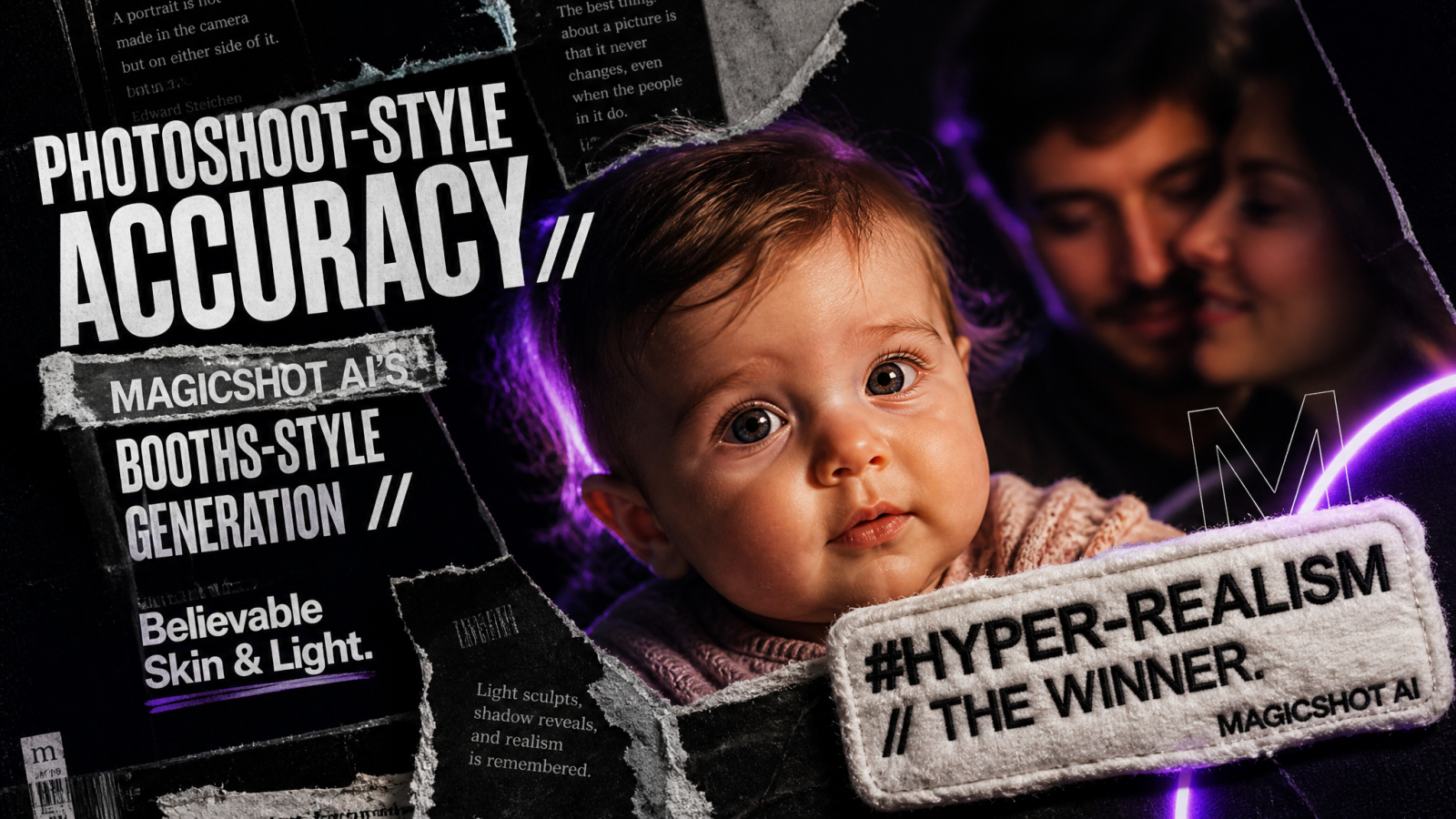
This category was the surprise of the test. Instead of a flat morph, these render the baby into a real-looking scene with proper lighting and depth of field. Resemblance was noticeably stronger because they treated both faces as references rather than smashing two sets of pixels together. MagicShot's AI Baby Generator sat in this group, and it was the one we kept re-running because the output looked like a photo somebody actually took rather than a digital composite.
5. The "premium" desktop tools
Higher fidelity, slower workflow. Great skin texture and clean symmetry, but the setup asked for more photos and more patience than most people will give a fun test on a Tuesday night. These are good results if you commit to the process, and overkill if you just want to text your partner a laugh before dinner. Know which camp you're in before you start.
6. The social-first generators
Built for sharing, these prioritize a clean vertical crop and a frame ready to drop into a story. Resemblance was hit or miss, but if your goal is a post rather than a keepsake, the format did its job well. Several nudged you toward paid packs within the first minute, so keep an eye on what you're agreeing to.
What separated the good tools from the gimmicks
After six runs, the pattern was obvious. The tools that scored well all did three things, and the ones that flopped skipped at least one of them.
They used both faces as real references. A weak tool leans on one parent and calls it a blend. A good one shows the dad's brow and the mom's smile in the same little face.
They rendered light, not just shape. Believable skin and a natural background sold the illusion far more than a slightly sharper morph ever did. Lighting is what makes a fake photo read as real.
They respected your time. Two clear steps, a fast result, and no bait-and-switch after you upload. The tools that made us hunt for the download lost points fast.
The gimmicks failed the resemblance test almost every time. They're built to be shared, not to be right, and that's a fine goal as long as you know it going in. The disappointment only happens when a cute-first tool is sold as an accurate one.
Tips to get a better AI baby prediction
Your inputs decide your output more than the tool does. We proved this by feeding the same generator a good photo and a bad one; the difference was night and day. A few things that measurably improved our results:
Use front-facing photos where both parents look straight at the camera.
Skip sunglasses, hats, and heavy makeup filters that hide real features.
Match the lighting between the two photos so one face doesn't dominate the blend.
Use recent, high-resolution shots. Grainy selfies produce grainy babies.
Run it two or three times. Small photo changes shift the result, and the second try is often the keeper.
If you like the result and want more than a single frame, it's easy to build on it. A baby photoshoot can drop that face into different scenes and outfits, and if you want to bring the still to life, Image to Video turns a favorite frame into a short clip you can send to family. That reveal video tends to land harder than a static image ever could.
Where these tools fit beyond the fun
A baby predictor is squarely a novelty, and that's the honest way to use it. But the underlying tech, reading faces and rendering realistic images, shows up across a lot of practical work. If you came for the baby test and stayed curious, the same rendering quality powers an AI art generator for original visuals from a text prompt. The point is that "read a face, render a photo" is a versatile trick, and the baby generator is just its most charming demo.
Our verdict on the best free AI baby generator
If you want the honest ranking: the photoshoot-style generators won on resemblance and image quality, the web predictors won on convenience, and the novelty filters won on pure fun. No single tool aced every category, so the best pick depends on what you're actually after. Want a believable face that mixes both parents? Go photoshoot-style. Want a quick laugh to text your partner? A novelty filter does the trick in under a minute.
The one thing to keep steady across all of them is your expectations. A baby generator is a well-made guess dressed up as a photo. Feed it two clear, well-lit pictures, run it a couple of times, and enjoy the surprise for what it is. Do that, and you'll walk away with a result worth sharing, no photographer, no waiting, no whose-nose debate required.