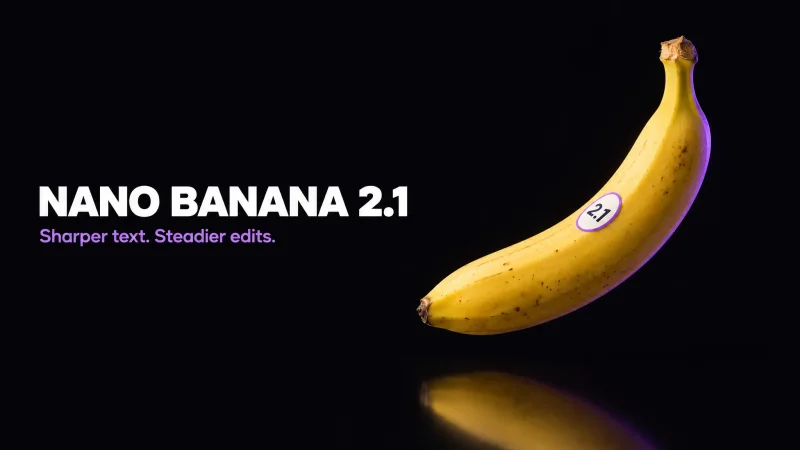
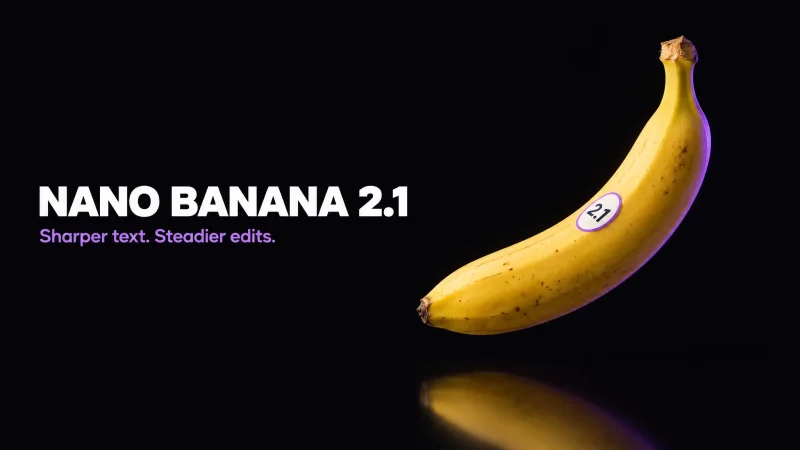
Nano Banana 2.1 is Google's image generation and editing model, published on October 6, 2026 as the follow-up to Nano Banana 2. It belongs to the Gemini 3 series and is built on Gemini 3.6 Flash, a natively multimodal model, so it takes text and images in and returns images and text.
On MagicShot, Nano Banana 2.1 runs in Image Editing and the AI Image & Art Generator. It draws from the same credit balance as every other tool in the app, so choosing it carries no separate fee. It is included on MagicShot's paid plans, and the commercial license that comes with them covers what you make with it.
What is new compared with Nano Banana 2
Google's model card compares Nano Banana 2.1 with Nano Banana 2 (Gemini 3.1 Flash Image) and Nano Banana Pro (Gemini 3 Pro Image). In Google's own side-by-side human evaluations, Nano Banana 2.1 scored above both in overall text-to-image preference and in every editing category the card lists: general editing, single- and multi-character consistency, mask and ink-based editing, product consistency, stylization and multi-reference editing.
Treat those as the maker's numbers, not an independent benchmark. Google reports them for the model's Thinking setting, so a single run in any app may not match them exactly.
Edit from up to 14 reference images
In Image Editing, Nano Banana 2.1 takes up to 14 uploads in one run, against 10 for Nano Banana 2. Refer to each upload by its position and say what it should contribute: "image 1 is the room, image 2 is the lamp, put the lamp on the side table." Then name what must stay: "Keep the walls, the rug and the lighting exactly unchanged."
Google's model card lists multi-image work, character editing and object and environment editing among the abilities it evaluates the model on.
Text inside images
Google lists clear text for posters and intricate diagrams, and localized text rendering across several languages, among the intended uses of Nano Banana 2.1. The card is just as direct about the limit: small text is often blurry at 1K resolution, and long paragraphs and page-length text are still weak. Keep on-image text short, and read every word before you publish.
Where it falls short
Google's model card lists these known limits:
Small text, long paragraphs and page-length text can render poorly.
Character consistency between the input image and the result is not always perfect.
In rare cases an edit keeps the structure and pose of the original image instead of following the new instruction.
Left and right, and other spatial placement, can get confused.
Advanced world knowledge, 3D reasoning and factual accuracy are still limited, and the model can hallucinate.
The underlying Gemini 3.6 Flash has a knowledge cutoff of March 2026, and some domains may only reflect knowledge up to January 2025.
Runs can occasionally be slow or time out.
Sizes, ratios and speed on MagicShot
Image Editing offers 1:1, 4:5, 5:4, 3:4, 4:3, 16:9, 9:16 and 21:9. Text to image adds 3:2 and 2:3. In Image Editing a run usually takes about 5 seconds, against about 25 seconds for Nano Banana 2.
What it costs on MagicShot
In Image Editing, Nano Banana 2.1 costs 122 credits a run. For comparison, Nano Banana 2 costs 480, Nano Banana 2 Lite 114, FLUX 3 Image 122 and GPT Images 2.5 Sunburst 800 in the same tool. In text to image it costs 120 credits, against 336 for Nano Banana 2 and 600 for Nano Banana Pro. Credits come from your plan's regular balance.
Where Nano Banana 2.1 fits among MagicShot's image models
Reach for Nano Banana 2.1 when you want quick edits from several references, or a fast first pass with readable text. Pick FLUX 3 Image when you want to dictate where each element sits, and GPT Image 2.5 Sunburst when an edit has to hold up under a close look. Nano Banana 2 remains available if you want the earlier model.