
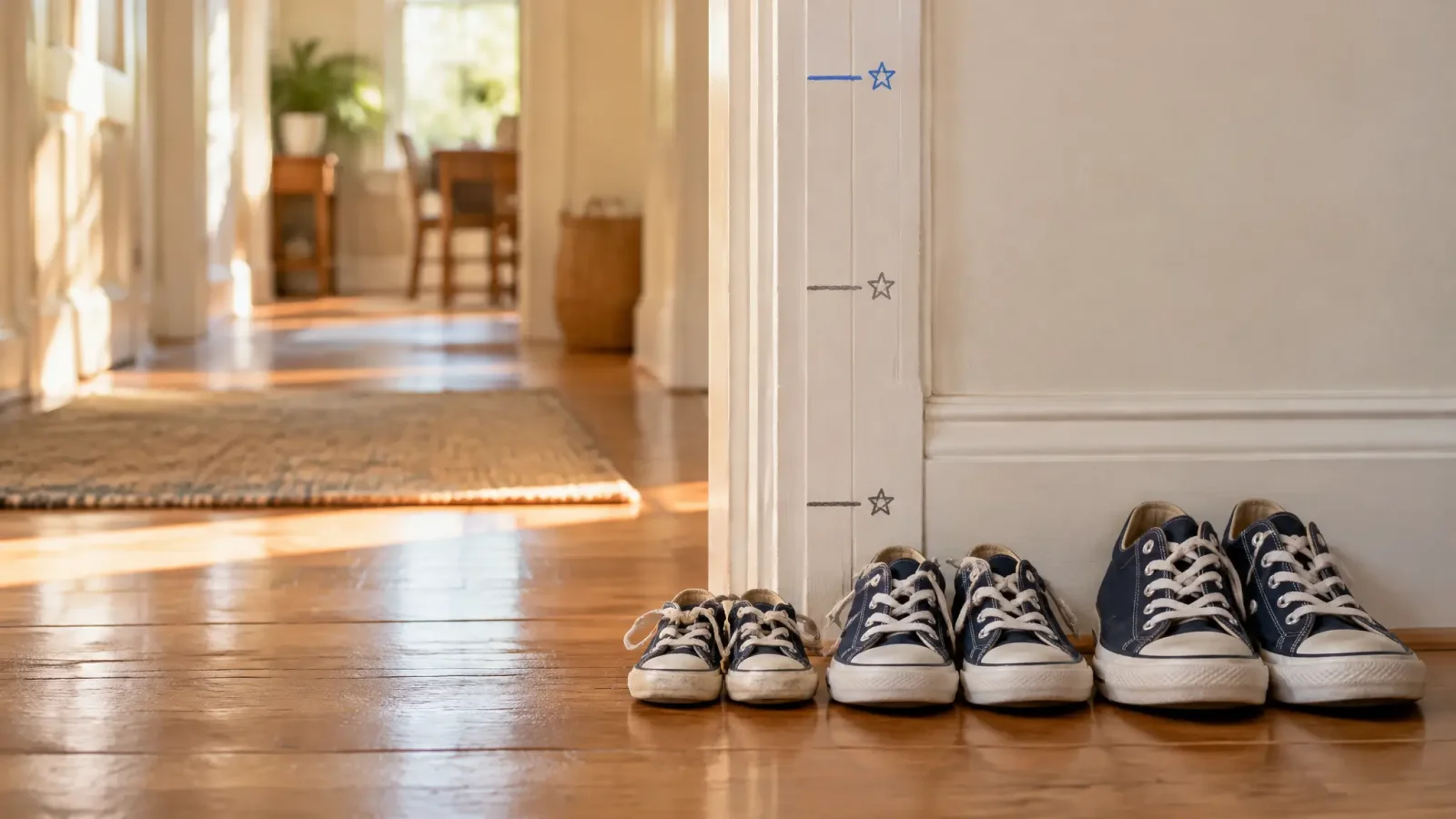
If you've searched what will my kids look like, you've probably found apps that hand you one soft-focus baby photo and call it done. MagicShot goes further. You can now preview your future kids at more than one age: as a toddler, as a five-year-old, and as a teenager, not just as a newborn. That's the real upgrade here, and it's the reason this post exists.
People type this question into Google a dozen different ways. What will our kids look like, what would my kids look like, what would my kid look like, what will my child look like, what would my child look like, what will our children look like, what will my future kids look like: it's all the same underlying curiosity, and the tool that answers it is the same one regardless of the phrasing. Upload a photo of each parent, pick an age, and let the model build the face.
How Faces Change From Baby to Child to Teen
A newborn's face is round, flat, and soft. The nose is small and the bridge hasn't formed yet, the jaw is short and set back, and the forehead takes up a larger share of the face than it will later. Eyes look proportionally large because the rest of the face hasn't caught up in size yet. This is also part of why two unrelated newborns often look more alike than two unrelated ten-year-olds do: the bone structure that makes an adult face distinctive, brow ridge, nose bridge, jaw angle, hasn't developed yet. Individuality in a face is mostly a function of cartilage and bone growth, and at birth that growth has barely started.
Pediatric growth charts describe the face maturing in roughly two phases: fast, noticeable change in the first few years, then a slower, steadier stretch through mid-childhood, followed by a final growth spurt at puberty that reshapes the nose, jaw, and chin more than any earlier stage. That's a mainstream, conservative way to think about it, and it's also why age-progression tools treat "child" and "teen" as genuinely different renders rather than a scaled-up toddler.
This also explains a familiar experience: it's often hard to tell newborn photos of siblings apart, while the same two kids look clearly distinct by kindergarten. The face hasn't finished sorting itself into an individual shape at birth, and each year of growth adds more of the detail that makes a face recognizably someone's own rather than a generic baby face.
By around age five, the face has lengthened. Baby fat in the cheeks starts to recede, the nose bridge has begun to define itself even though the cartilage stays soft for years yet, and the eyes look more proportional as the rest of the face grows to match them. This is usually the age a child starts to look like a smaller, distinct version of themselves rather than a generic toddler.
The teen years, roughly thirteen to sixteen, bring the biggest structural changes. Growth during puberty affects the jaw and nose more than any other feature: the jawline squares off and comes forward, cheekbones become more visible, and the nose grows in both length and width, sometimes changing its apparent shape entirely. This is also the stage where a resemblance to one parent that wasn't obvious at five can suddenly show up. A teenager's face sits much closer to its adult shape than a child's does.
Which Parental Traits Show Up Early, and Which Show Up Late
Some features are visible almost immediately and stay fairly stable. Ear shape is one: ears are largely set by birth and don't change proportion much with age, so an inherited ear shape is often recognizable in a baby photo years before anything else lines up. Skin tone and general hair texture usually show up early too, though hair color is notoriously unstable in the first few years. Plenty of babies are born with lighter hair or lighter eyes that darken by age two or three as pigment keeps developing.
Other features are late bloomers. Nose shape and jaw structure are the two biggest examples, and they're exactly the features that keep changing through the teen growth spurt described above. That's why a child can look like a near-even blend of both parents at five and then start favoring one parent's profile noticeably by fifteen, once the nose and jaw finish most of their growth. Overall face shape sits in between: it shifts gradually and keeps refining itself well into the teen years, which is part of why a single-age baby prediction only tells part of the story.
Expression habits add another layer that a static newborn photo can't capture. A parent's characteristic smile, or the way their eyebrows sit when they're concentrating, tends to show up in a child gradually, through years of shared muscle use and mimicry, not from one generated frame. It's part of why a five-year-old or teenage render can look more like "them" in a way a newborn version usually doesn't: there's simply more developed face for a resemblance to sit on.
How to See What Will My Kids Look Like at Every Age
MagicShot's Baby Predictor tool is built around exactly this problem: most baby generators only give you a newborn. Here's the actual workflow.
Most baby-face generators stop at a single newborn output because it's the easier image to fake convincingly: round cheeks and soft, generic features hide a lot of a model's limitations. Getting a five-year-old or a teenager to look like a believable extension of the same two parents, with a squarer jaw, a more defined nose, and adult-proportioned features, is a harder problem, and it's specifically what the age setting on the Baby Predictor is built to handle.
Upload two parent photos. Clear, front-facing photos in good light work best, one photo per parent.
Choose gender. Boy, girl, or twins.
Set the age. This is the setting most competitors skip entirely. Choose baby for a newborn look, child for around age five, or teen for around age fifteen.
Pick a photo type. A solo baby portrait, or a family photo that places the generated child alongside both parents in one frame.
Add a style or custom prompt if you want one. Optional, but useful if you're aiming for a particular setting, outfit, or mood.
Generate. You get a photo-real image built from the two source photos and the settings you picked.
To build a real age-progression comparison, run it three times with the same two parent photos and the same style, changing only the age setting between runs: baby, child, teen. Because the source photos and style stay fixed, the three outputs read as one child face aging rather than three unrelated kids. In practice, that consistency is the real test of whether an age setting is doing actual work: the toddler, the five-year-old, and the teen should clearly share bone structure, not just a family resemblance in the loosest sense.
The family photo option inside the baby generator deserves its own mention. Instead of a solo portrait of the generated child, MagicShot can place your future kid in a frame alongside both parents, useful for a holiday-card mockup, a "what our family might look like" post, or just a more natural result than a floating headshot on its own. Switch between the solo and family photo type without changing anything else and compare both.
The twins gender option works the same way, generating two related child faces from the same two parent photos rather than editing one image into two. If you're curious how siblings might differ from each other rather than how a single future child might look, running the twins setting is the more useful test, and it's still built from the same age controls described above.
A few things noticeably improve the output. Use recent, well-lit photos where the face is mostly forward-facing and not obscured by sunglasses, hats, or heavy shadow. Avoid group photos where the model has to guess which face belongs to which parent. If an early result doesn't feel close enough, regenerating with the same inputs produces a fresh variation, since the model isn't returning one single fixed answer each time you run it.
If the question that got you here is really about your own face aging rather than your child's, MagicShot's Age Journey tool runs a similar age-based process on a single uploaded photo instead of two.
One practical note on photos: only upload images you have the rights to use, and check MagicShot's privacy policy if you want specifics on how uploaded photos are handled before you upload a photo of your kids or partner.
"AI Kid" and "Kid Simulator" Searches: Using the Output for Content
A lot of people typing future kid ai, ai kid, kid ai, or kid simulator into a search bar aren't planning a family at all. They're making a reaction video, a couple's Instagram post, or a short about what a child might look like with a partner, an ex, or a celebrity crush. That's a normal use case, and the tool handles it the same way it handles the parenting use case.
The workflow doesn't change. Upload two face photos, set an age, generate an ai future child, and download the result. For a consistent child face across a before-and-after post, keep the two source photos and the style locked and only change the age between runs. That's what produces a toddler, a kid, and a teen version of the same child face instead of three unrelated ones.
Common formats include a "meet our future kid" reveal, a three-age comparison post showing the toddler, child, and teen versions in one carousel, or a reaction video where a couple sees the result for the first time on camera. All of them work off the same two-photo, pick-an-age workflow described above, just aimed at an audience instead of a family album.
One honesty note, worth saying plainly: this is a generated image, not a scientific prediction of a specific future child. Real inheritance involves thousands of genetic variables that no photo model can read from two pictures. Label AI-generated content as AI-generated if you're posting it publicly. An audience will happily engage with a labeled AI toddler concept; they respond badly to being told it's a real prediction when it plainly isn't.
Read Next
More from this cluster:
What Will My Baby Look Like? covers the newborn-stage basics and how the core predictor works.
What Will My Son or Daughter Look Like? breaks the question down by gender.
Age Journey for aging your own photo instead of a future child's.