
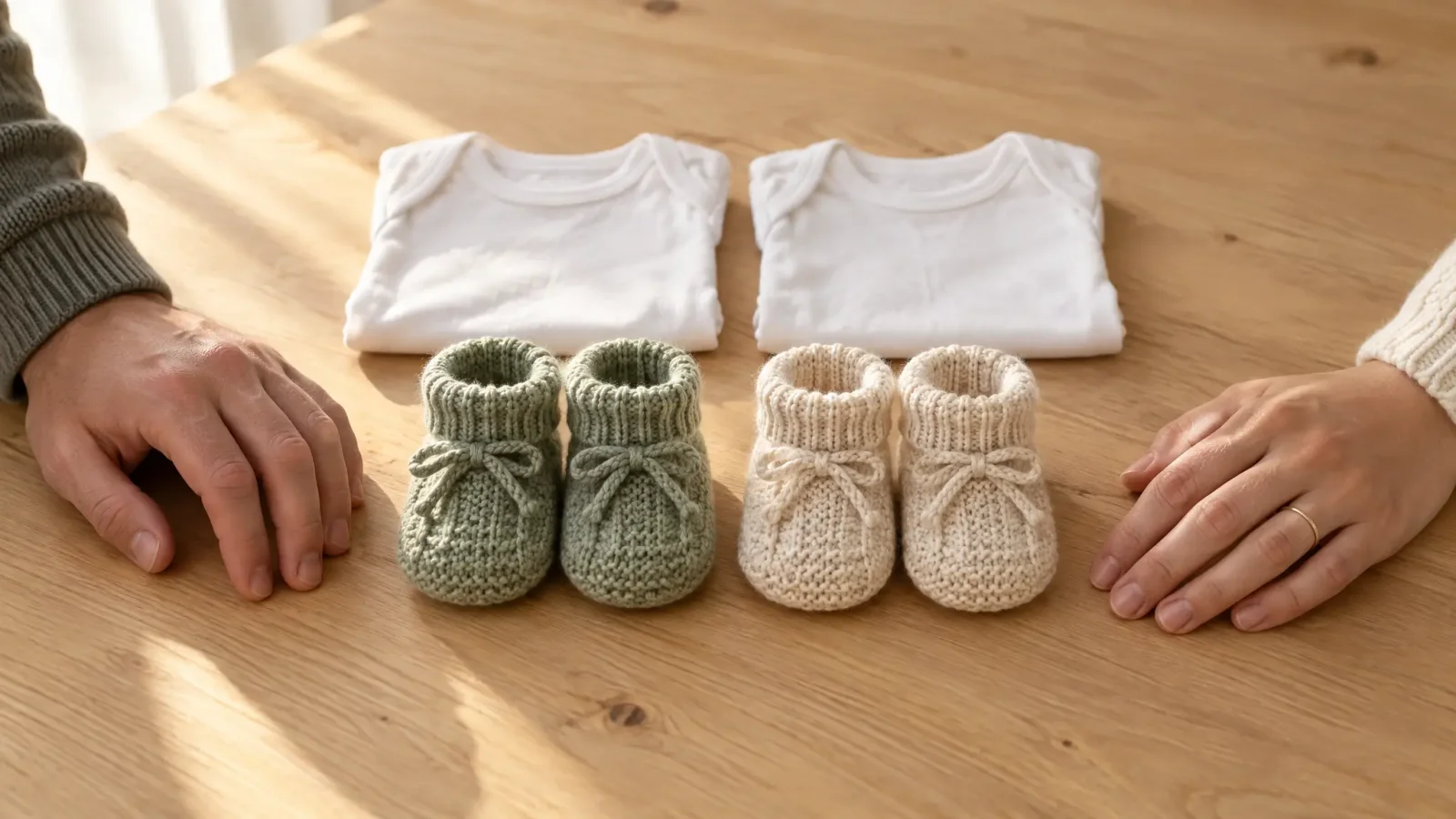
An odds of having twins calculator can only ever give you a probability, not a guarantee. Here is the direct answer: about 3 in 100 births in the United States are twins, according to CDC natality data. That 3 percent baseline moves up or down based on real factors like your age, your family history, and whether you are using fertility treatment. Fraternal twins run in families, mostly through the mother's side, because the tendency to release two eggs in one cycle is partly inherited. Identical twins are mostly a matter of chance and do not run in families in any dependable pattern.
This is a probability estimate built from population statistics, not a medical prediction about your specific pregnancy. Below is a scored checklist you can use to estimate your own chances of having twins, followed by what the research actually says about each factor.
Odds of Having Twins Calculator: Score Your Own Chances
People search this several ways: twins calculator, chances of having twins, and what are the odds of having twins. All three point to the same checklist. Work through the list below, add up the points that apply to you, and check the ranges at the end.
Starting point (+3): Everyone begins here. This represents the roughly 3 in 100 baseline rate for US births.
Maternal age 30 to 34 (+1): Rising FSH levels make releasing two eggs in one cycle somewhat more likely as women move through their 30s.
Maternal age 35 or older (+2 instead of the row above): The same hormonal shift is more pronounced by the mid-30s. Use this instead of the 30-to-34 point, not in addition to it.
Family history of fraternal twins on your mother's side (+2): If your mother, a sister, or a maternal aunt had fraternal twins, you may carry the same tendency toward double ovulation.
You have had a twin pregnancy before (+2): Women who have already had fraternal twins have a higher-than-average chance of having them again.
Above-average height, roughly 5'7" or taller (+1): A few population studies link maternal height to insulin-like growth factor and a slightly higher rate of double ovulation. The evidence here is moderate, not definitive.
BMI of 30 or higher (+1): Some studies associate higher BMI with hyperovulation. Like the height link, this is a real but modest pattern, not a strong predictor on its own.
Using IVF with more than one embryo transferred (+10): This is the single biggest lever on the list. Transferring two embryos can push twin odds well above 20 percent.
Using ovulation-inducing fertility drugs like Clomid without IVF (+5 instead of the row above): These drugs raise the odds of releasing multiple eggs, though less dramatically than a two-embryo IVF transfer.
African or West African ancestry (+2): Twinning rate studies consistently show higher rates of fraternal twinning in populations with African ancestry. This is a documented epidemiological pattern, not a judgment about any individual.
European ancestry (+1): Rates sit in the middle of the global range, above East Asian populations and below West African populations.
East Asian ancestry (-1 instead of the two rows above): Population studies consistently show the lowest fraternal twinning rates in East Asian populations. Use this instead of the ancestry rows above, not alongside them.
Three or more previous pregnancies (+1): Fraternal twinning rates climb slightly with each pregnancy, independent of age.
Regular dairy or animal protein consumption (+1): One small, often-cited 2006 study linked dairy intake to higher twinning rates. It has not been well replicated, so treat this factor as weak and contested, not settled science.
Add up your points. A score of 3 to 5 keeps you close to the national average, around 3 in 100. A score of 6 to 9 puts you meaningfully above average, closer to 1 in 20. A score of 10 or higher, which usually means IVF with more than one embryo transferred, can push the odds toward 1 in 4 or higher at some clinics. Treat this as a rough estimate for curiosity, not a lab result, and remember that the US twin birth rate has climbed over the past several decades largely because more women are having children later and using fertility treatment, not because any single factor changed.
Identical vs Fraternal Twins: What's the Difference?
Fraternal twins come from two separate eggs fertilized by two separate sperm. They share about 50 percent of their DNA, the same as any siblings, and can be different sexes. Identical twins come from a single fertilized egg that splits into two embryos early on. They share nearly all of their DNA and are always the same sex.
Fraternal twinning has a genetic component on the mother's side, tied to the tendency to release more than one egg per cycle. Identical twinning does not run in families in any dependable pattern. Researchers still treat the splitting event as close to random, though a handful of studies suggest a very small genetic influence on it that is not well understood.
How Do Doctors Confirm a Twin Pregnancy?
An ultrasound is the only reliable way to confirm twins, usually performed between 6 and 9 weeks. Before that point, a few signs can raise suspicion: an hCG level higher than expected for the pregnancy stage, more severe morning sickness, or measuring larger than expected at a prenatal visit.
None of these signs confirm twins on their own. hCG ranges overlap heavily between single and twin pregnancies, and measuring larger can just mean a miscalculated due date. If you suspect twins, an ultrasound with your provider is the only way to know for sure. This guide, including every point value in the checklist above, is meant for curiosity and planning. It is not medical advice and does not replace care from your doctor or midwife.
What Would Twins Actually Look Like? Preview Them With AI
The Baby Predictor tool has a twins option built into the gender setting, alongside boy and girl. Upload one photo of each parent, select twins, choose an age (baby, child around 5, or teen around 15), and pick a solo baby image or a family photo with both parents included. The tool generates two related but distinct faces in a single pass, the way real fraternal twins would actually look: sharing family features without being mirror images of each other.
By the time an ultrasound confirms a twin pregnancy, most parents are already asking what will our babies look like, or phrased differently, what would our babies look like if they turn out to be twins. I ran several pairs of parent photos through the Baby Predictor with twins selected, and each output gave two faces with a clear family resemblance to each other and to both parents, not two copies of the same generated child. That matches how fraternal twins work in practice: same two parents, same pool of inherited features, a different combination drawn each time.
Try the twins option on the Baby Predictor, or start with a single baby prediction first if you want one face before generating two. MagicShot runs on a subscription with credits, there's no free tier, but one plan covers every combination of gender, age, and style across both parents' photos, so you can try twins, then a boy, then a teen version, without buying anything new each time. Check the site for current plans before you generate. For anything about how your uploaded photos are stored, read the privacy policy rather than assuming a retention rule.
Read Next
What Will My Baby Look Like? covers the full genetics quiz for eye color, hair, and face shape predictions, and explains how the underlying tool works in more detail.