
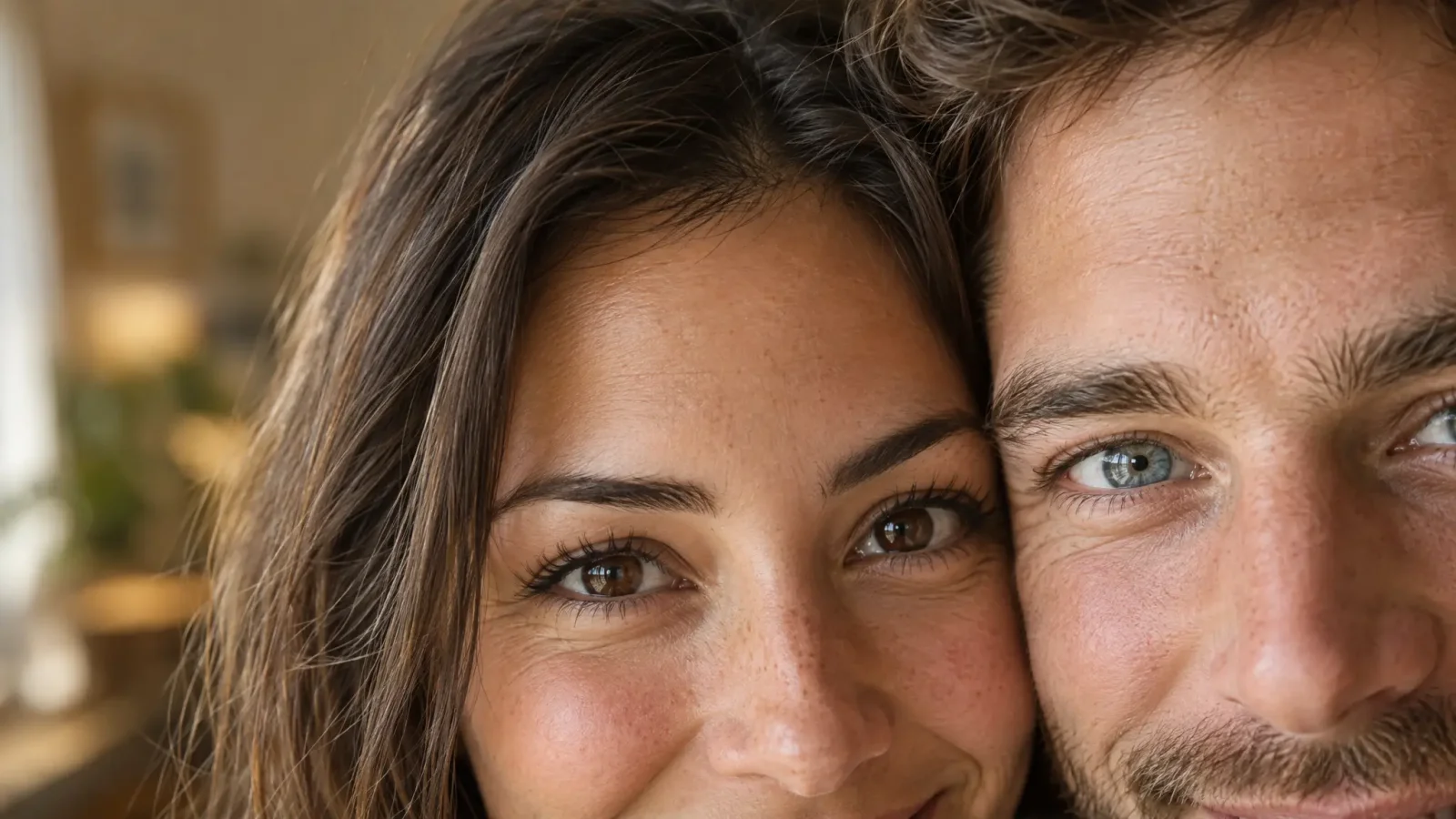
Eye color depends mainly on two genes, OCA2 and HERC2, working alongside a handful of smaller genes that add or subtract pigment. Brown is the dominant, most common result worldwide, but dominant does not mean guaranteed. Two blue-eyed parents will almost always have a blue-eyed baby, because blue eyes need two matching low-pigment gene copies and neither parent has a brown version to hand down. Two brown-eyed parents can still end up with a blue-eyed baby if both happen to carry a hidden blue variant passed down from their own parents. A baby eye color calculator cannot name the exact shade your child will have on day one. What it can do is turn both parents' eye colors into realistic odds, using the same genetics that shape eye, hair, and skin pigment together.
What Color Eyes Will My Baby Have? The Short Version
Genetics counts the odds; nobody can promise a shade before the baby is born. Brown wins more often than not, since it is the dominant pigment pattern across most family trees, but blue and green show up more than the old textbook model suggests. You will see this same idea called a baby eye color predictor, an eye color calculator, or an eye color genetics chart, depending on where you search. They are all doing the same math: two parent eye colors in, a spread of realistic outcomes out. Read the odds as a range, not a promise, and you will use the chart below the right way.
Baby Eye Color Calculator Chart: Odds by Parent Combination
Find both parents' eye colors in the left two columns, then read across for the approximate spread. These are ranges pulled from population-level genetics, not a lab result for your specific baby, and the four columns will not always add up to a clean 100 percent, since some combinations (heterochromia, unusually light eyes, or a rare pigment variant) fall outside the four main buckets.
Parent 1 | Parent 2 | Brown | Blue | Green | Hazel |
|---|---|---|---|---|---|
Brown | Brown | Likely, 55-75% | Possible, 5-15% | Possible, 5-15% | Possible, 10-20% |
Brown | Blue | Likely, 45-65% | Possible, 20-40% | Possible, 5-15% | Possible, 10-20% |
Brown | Green | Likely, 45-60% | Possible, 5-15% | Possible, 20-35% | Possible, 10-20% |
Brown | Hazel | Likely, 45-60% | Possible, 5-15% | Possible, 10-20% | Possible, 20-30% |
Blue | Blue | Rare, under 1% | Very likely, 90-99% | Unlikely, 0-5% | Unlikely, 0-5% |
Blue | Green | Rare, 0-5% | Likely, 40-55% | Likely, 30-45% | Possible, 10-20% |
Blue | Hazel | Unlikely, 0-10% | Likely, 40-55% | Possible, 10-20% | Possible, 25-40% |
Green | Green | Unlikely, 0-10% | Possible, 5-20% | Likely, 55-70% | Possible, 15-25% |
Green | Hazel | Possible, 5-15% | Possible, 5-20% | Likely, 35-50% | Likely, 30-45% |
Hazel | Hazel | Possible, 10-25% | Possible, 5-20% | Possible, 15-25% | Likely, 40-55% |
Brown (has a blue-eyed parent) | Brown (has a blue-eyed parent) | Possible, 50-60% | Possible, 20-30% | Possible, 5-10% | Possible, 10-20% |
Brown (child of two blue-eyed parents) | Blue | Unlikely, 0-10% | Likely, 55-70% | Possible, 5-15% | Possible, 15-25% |
Rows 11 and 12 matter more than they look. A brown-eyed parent who themselves has a blue-eyed parent is very likely carrying a hidden blue variant, even with brown eyes. That single hidden copy changes the odds meaningfully, which is exactly why a simple two-color chart, just mom's eye color against dad's eye color, misses real cases. The next section explains why, and what a more accurate model actually looks like.
Why the Old Brown/Blue Punnett Square Gets Eye Color Wrong
For decades, the standard classroom explanation treated eye color like a single gene, with brown dominant over blue, the same way you would predict pea plant color in a high school biology class. That model is easy to teach and mostly wrong. Real eye color comes from at least eight to ten genes working together, a polygenic trait in the same family as height or skin tone.
Two genes do most of the work. OCA2 controls how much melanin gets produced in the iris; more melanin means darker eyes, less means lighter. HERC2 sits right next to OCA2 on chromosome 15 and acts like a dimmer switch, controlling how active the OCA2 gene actually is. A particular HERC2 variant can turn OCA2 down low enough to produce blue eyes even when the OCA2 gene itself is a "brown" version. Beyond those two, smaller genes such as SLC24A4, TYR, and IRF4 nudge the final shade toward green, hazel, amber, or a lighter or darker version of brown.
That is why a single-gene Punnett square, the kind with four boxes and a 3:1 ratio, cannot actually predict eye color with any precision. It can explain the rough direction (two blue-eyed parents rarely produce a brown-eyed baby) without explaining the exceptions, the shade variation, or where green and hazel come from at all. A calculator built on real population data, like the chart above, handles those cases better than a two-gene guess ever could.
When Do Baby Eyes Change Color?
Most of the change happens in the first six to twelve months. Babies, especially light-skinned babies, are often born with grayish-blue or slate-colored eyes regardless of what color they will settle into, because melanin has not finished accumulating in the iris at birth. As melanin builds up over the following months, eyes darken toward their more permanent color: blue can shift to green or brown, and a newborn hazel tint can deepen or lighten depending on how much pigment develops.
Six months is the point where a lot of the shift has already happened, but it is not the finish line. Some babies keep shifting in smaller ways up to age one, and a smaller number keep changing subtly out to age three. After that, eye color is generally stable for the rest of childhood and adulthood, aside from very gradual changes some people notice much later in life.
If your baby's eyes look nothing like what the calculator above suggested at two months old, that is not a sign the chart is wrong. It is usually a sign the eyes just are not done developing yet.
Grandparents Matter: Where Surprise Eye Colors Come From

A recessive allele can hide for a generation and resurface in the next one without warning. If a brown-eyed parent had a blue-eyed parent themselves, there is a strong chance they are carrying a silent copy of a blue-eye variant alongside their dominant brown one. Pair that parent with another carrier, even another brown-eyed one, and a blue-eyed baby becomes a real possibility, not a fluke.
This is why grandparents' eye colors are worth checking before you lock in an answer from a chart. Two brown-eyed parents with four brown-eyed parents between them are genuinely less likely to have a blue-eyed baby than two brown-eyed parents where one or both sides has a blue-eyed grandparent tucked into the family tree. The gene did not disappear when it skipped a generation. It was just outvoted by a dominant partner and waiting for the right pairing to show up again.
The same logic applies to green and hazel, which behave less predictably than blue but still run in families for the same underlying reason.
From Odds to a Face: Preview the Whole Baby With MagicShot
A calculator gives you odds for one trait at a time. It will not show you how that eye color actually sits in a face, next to a nose shape, a hairline, and a skin tone that are all inherited independently. For that, an AI preview is the more useful next step, and it is worth pairing with the chart above rather than using either tool alone.
The MagicShot Baby Predictor works from two real parent photos instead of a list of traits. Upload one clear, front-facing photo of each parent (even lighting, no sunglasses or hats, one face per photo works best). Pick a gender: boy, girl, or twins. Pick an age: baby, a child around age 5, or a teen around age 15. Pick a photo type: a solo shot of the baby, or a family photo with both parents in frame. Generate, and the result is a photo-real image built from the features in both uploaded photos, usually in under a minute.
The tool is not reading your eye color odds off the chart above and inserting them. It is blending facial features from the actual photos you uploaded, the same way a real child inherits a mix of both parents' features. Used together, the two tools cover different questions: the chart above answers what color, roughly, and the Baby Predictor answers what the whole face might actually look like.
Read Next
Who Will My Baby Look Like, Mom or Dad?
What Will My Son or Daughter Look Like?