
Meta just showed what it thinks comes after the headset. At Meta Connect on September 23, 2026, the company unveiled Meta VR Glasses, a lighter, sharper class of hardware built around micro-OLED displays and an AI layer that runs through everything from navigation to video calls.
What Meta Announced
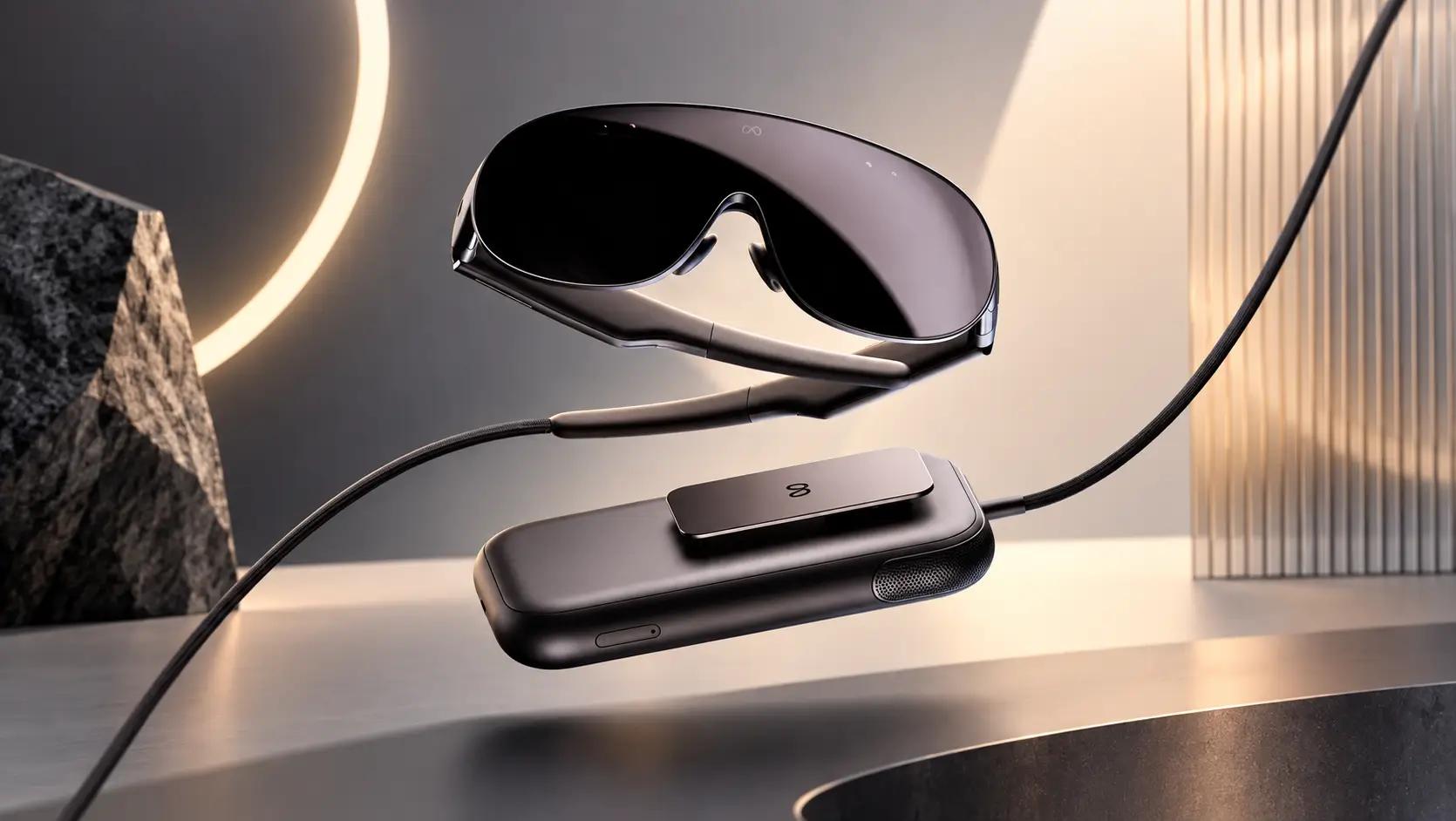
Meta VR Glasses mark the company's first non-LCD headset since the original Oculus Quest. Instead of the bulky, self-contained design of Quest 3, the glasses weigh around 100 grams and offload all computing to a separate puck connected by a fiber optic cable. Meta is calling it the start of a new era for virtual reality, and the pitch leans hard on comfort, clarity, and AI-driven interaction rather than raw power.
Inside the Hardware
Weight: about 100g for the glasses, with a roughly 300g compute puck
Display: dual 120Hz micro-OLED panels, 2,412 x 2,288 pixels per eye, 37 pixels per degree
Field of view: 70° horizontal by 66° vertical, about 87° diagonal
Chip: Qualcomm Snapdragon Reality Elite (XR2 Gen 3 class), 12GB RAM, 128GB storage expandable via microSD
Tracking: eye tracking, hand tracking, and face tracking built in
Battery: 3+ hours of mixed use from the puck, 45W USB-C charging
Controllers: sold separately, compatible with existing Quest 3 and 3S controllers
Sharper Screen, Narrower View
The tradeoff against Quest 3 is straightforward. Meta VR Glasses deliver a much higher angular resolution, 37 pixels per degree versus roughly 25 on Quest 3, thanks to micro-OLED panels, but the field of view narrows to about 87° diagonal, down from Quest 3's roughly 130°. Meta is betting that sharper, more natural-looking visuals matter more than an ultra-wide view for its target use cases: video calls, streaming, and light gaming rather than full-room VR.
The AI Layer Is the Real Story
Specs aside, the more interesting move is what Meta built into the software. The glasses ship with Meta AI voice control built into navigation, plus a hologram feature that turns a face-tracked scan into a photorealistic avatar for video calls. It's a 2.5D stereoscopic version at launch, with full 6DoF 3D avatars planned down the line.
That's a signal worth watching even outside VR. Meta is putting real weight behind AI-generated, photorealistic representations of real people as the default way to show up on a call. It's the same shift already playing out in AI photoshoots, avatar generators, and UGC video tools: a person's likeness, rendered by AI, standing in for the real thing.
What It Means for Creators
None of this requires a $1,300 headset to matter. As holographic calls, digital avatars, and AI-generated likenesses become normal on mainstream platforms, demand for a clean, photorealistic starting image only grows, whether that's a professional headshot, an avatar, or a UGC-style video. That's ground MagicShot's AI Photoshoot and Avatar Generator tools already cover, minus the hardware and the 2027 wait.
Price and Availability
Meta VR Glasses are priced at $1,300 and are set to ship in spring 2027 across North America, Europe, and Asia-Pacific. More than 75 games and apps are already optimized for the hand-tracking-first interface, including adapted versions of Beat Saber and Tetris Effect, alongside streaming support for Disney+, HBO, Peacock, Prime Video, and YouTube.