
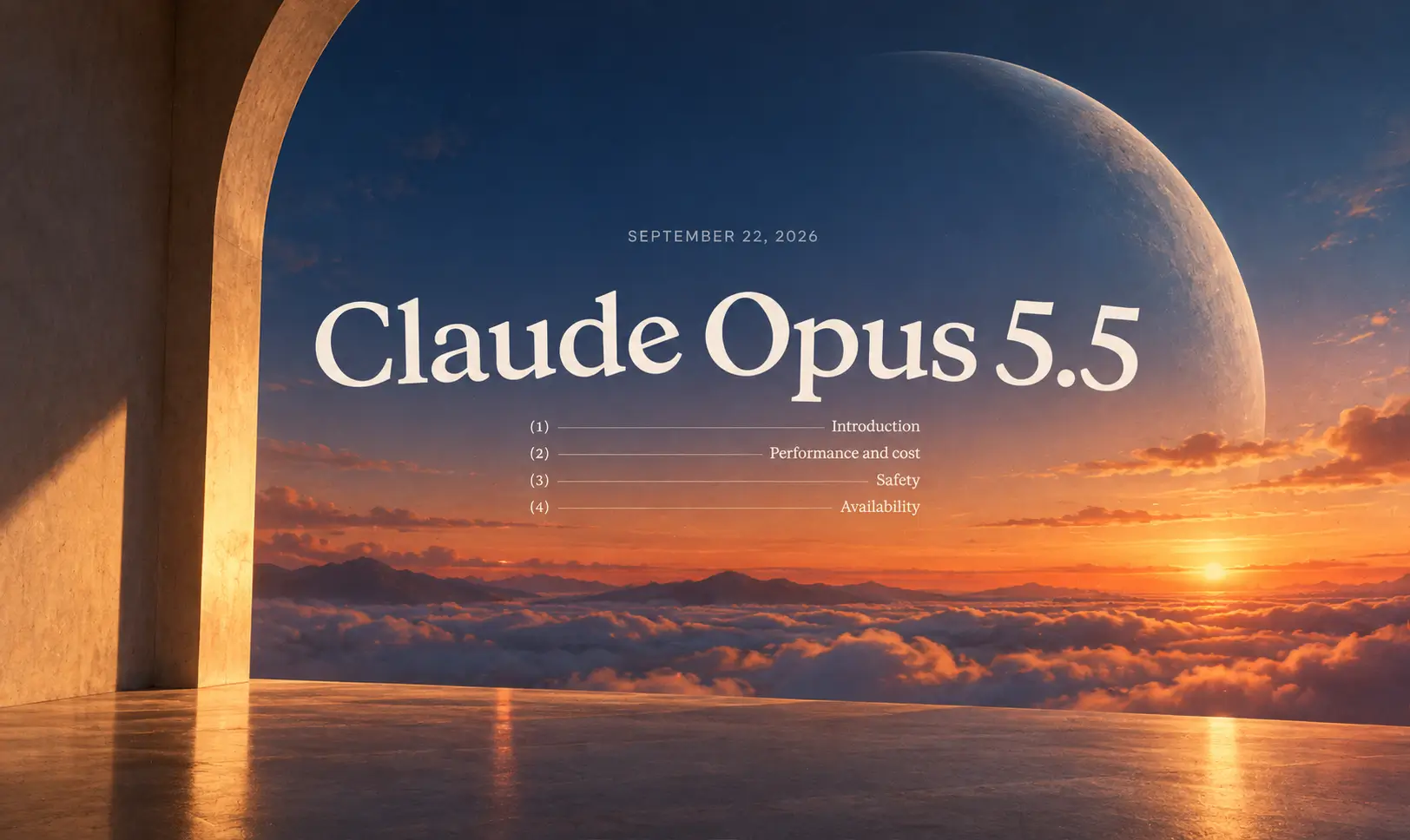
Anthropic has released Claude Opus 5.5, the first model in its new Claude 5.5 family, and it's an unusual kind of upgrade: substantially cheaper and faster to run than its predecessor, while testing stronger across coding, research, and agentic benchmarks. Here's what actually changed, and why it matters if you build with AI or just want to keep up with how fast the underlying models are moving.
What's new in Claude Opus 5.5
Claude Opus 5.5 performs at roughly the level of Anthropic's own Claude Fable 5.1 on most everyday work, but gets there for 40% less than Opus 5 costs to run and generates responses about 30% faster. Anthropic is positioning it less as a bigger model and more as a more efficient one, a trend that's becoming common across the industry as labs compete on cost per task rather than raw scale.
Coding and agentic work: one tester completed a 680,000-line code migration in under a day, work that previously took teams weeks.
Research and knowledge work: 16 of 18 generated reports passed quality checks with no fabricated figures or quotes.
Communication: outputs are clearer and less jargon-heavy, prioritizing the most important information first.
Security: stronger resistance to prompt injection attacks across every scenario Anthropic tested.
Benchmarks and pricing
The gains show up across the board. On Terminal-Bench 4.0, Opus 5.5 scores 66.4% versus 52.3% for Opus 5. On GDPval-AA v2.1, a benchmark of real-world professional tasks, it hits 1846 Elo versus 1708. On OSWorld 2.0, a computer-use benchmark, it reaches 81.8% versus 74.0%.
Pricing dropped alongside the performance gains: input tokens are now $4 per million (down from $5), output tokens are $20 per million (down from $25), and cached reads fell 60% to $0.20 per million. A faster "Fast Mode" is also available at $8 input / $40 output per million tokens for roughly 2.5x the speed. Claude Opus 5.5 (model ID claude-opus-5-5) is live now on the Claude Platform, AWS, Google Cloud, and Microsoft Azure, with Sonnet and Haiku versions of the 5.5 family expected in the coming weeks.
Why this matters
Benchmark charts are one thing; what's more telling is how fast real teams are putting these gains to use. GitHub's CPO said Opus 5.5 solved more tasks in fewer steps inside VS Code. Deloitte Consulting reports it caught 72% of known bugs at its lowest effort setting, versus 56% for Opus 5 running at high effort. Optiver cut agentic coding costs 40-50% while matching Opus 5's output quality in half the turns. The common thread: teams are getting comparable or better results for meaningfully less compute, and less waiting.
Where MagicShot.ai fits in
We're not in the business of building foundation models like Claude, our focus is the 500+ image and video models and the creative tools that power AI photoshoots, photo editing, and content generation for creators and marketers. But releases like Claude Opus 5.5 are still worth watching closely, because the pace of progress at the model layer is exactly what makes creative AI tools faster, cheaper, and more capable every few months. A 40% cost cut and a 30% speed boost at the frontier level is the kind of shift that eventually trickles down into every AI product people actually use.
If you're a creator or marketer trying to keep pace with how quickly AI is moving, not just in image and video generation but across the board, it's worth treating each of these model releases as a signal of where the ceiling on quality, speed, and cost is heading next.
Explore MagicShot's full suite of AI creative tools, from AI photoshoots to product photography to image-to-video generation, built for creators who want to move as fast as the models powering them.