A word that reads the same upside down sounds like a party trick until you try to draw one. Getting every letter to double as another letter, or to survive a 180 degree turn, is a real lettering puzzle. That is why people look for an ambigram tattoo generator. If you only want a name in a handsome script, that is a simpler job. Both start in the tattoo generator, and this post covers how to choose, what words work, and what to check before the design goes anywhere near an artist.
What an ambigram actually is
An ambigram is lettering that reads correctly from more than one direction. A rotational ambigram still reads when you turn it 180 degrees. A mirror ambigram reads the same when reflected across a line. Some are even clever enough to read as two different words, such as a name one way and a meaning the other way. They are as much a puzzle as a style, which is why hand-drawing one without training is hard.
Which words work well
Short words. Four to seven letters is the sweet spot.
Symmetrical letters. O, X, H, S, N and Z flip or mirror easily.
Fewer tall and low strokes. Letters with long ascenders and descenders, like f, g, y and p, fight the rotation.
Single words or a pair of linked names. Whole sentences rarely survive.
Some words simply do not convert cleanly. Generate several options and check both orientations before choosing, because a design that looks great right-side up can fall apart upside down. Ask someone who has not seen the word to read it both ways. If they hesitate, the design needs work.
Name tattoos in decorative script
If you do not need the two-direction trick, a name design just applies a lettering style. Three styles cover most requests:
Cursive script: flowing, connected letters. Works well for a single first name.
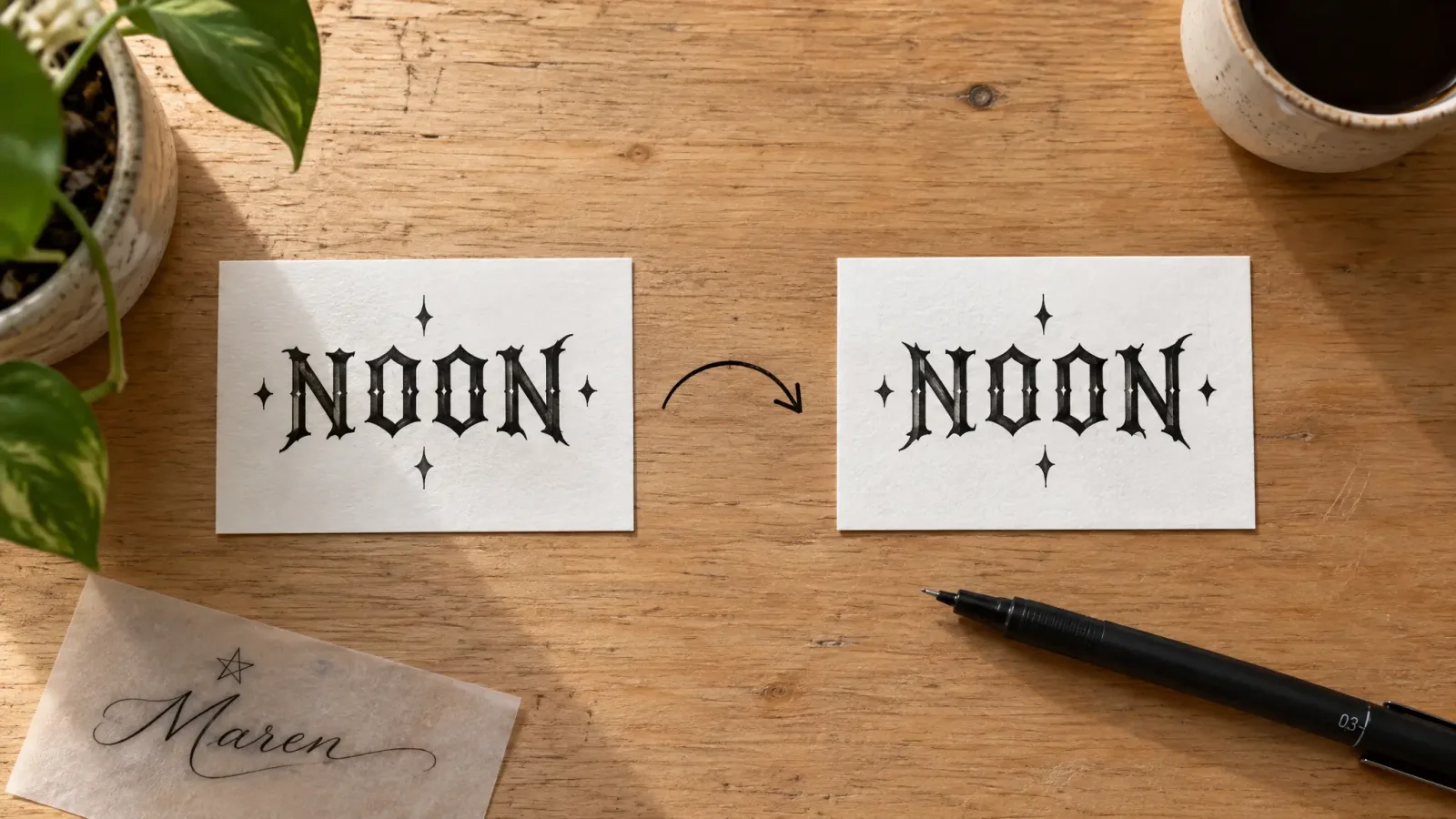
Blackletter: bold, angular strokes with weight. Suits a surname or a strong single word, but is harder to read at small sizes.
Minimal serif or sans-serif: clean, simple lettering that suits a wrist, finger or behind-the-ear placement.
Adding a small symbol
A heart in place of a dot, a vine trailing from the last letter or a star between two names adds meaning without crowding the text. Put the symbol and its position in the same prompt as the name, for example "cursive Maren, small star above the M", so it is placed on purpose.
Checks before you book a tattoo artist
1. Spelling and meaning. Check the name or word twice, and have someone else read it. If the text is in another language or script, confirm the translation with a native speaker.
2. Size and placement. Thin lines and tiny letters can blur together as a tattoo ages. Ask your artist the smallest size that will stay legible on that body part.
3. Print a test. Print the design at actual size, cut it out and tape it where it will go. Live with it for a few days.
4. Treat the output as a concept. AI tools give you the idea and a reference. A professional artist redraws it for skin, adjusting line weight and spacing. Many will want to redraw it anyway.
What to do next
To combine your lettering with another concept, see the tattoo idea generator. To prepare a design for your artist, read the tattoo stencil maker guide. The tattoo generator handles the lettering and the export.