YouTube search is about to stop acting like a 2010 search box. At Google I/O 2026 on May 19 at Shoreline Amphitheatre in Mountain View, Google announced Ask YouTube, a Gemini-powered conversational search feature that lets you ask messy, real-world questions and get back a written answer plus video clips that jump to the exact timestamp you need. CEO Sundar Pichai called it out personally in the keynote. Not a footnote. A flagship. The feature first surfaced quietly as a YouTube Labs experiment on April 28, 2026, available only to YouTube Premium subscribers in the US who are 18 or older. The wider rollout is set for this summer, US only, with no international date on the board yet.
What Ask YouTube actually does
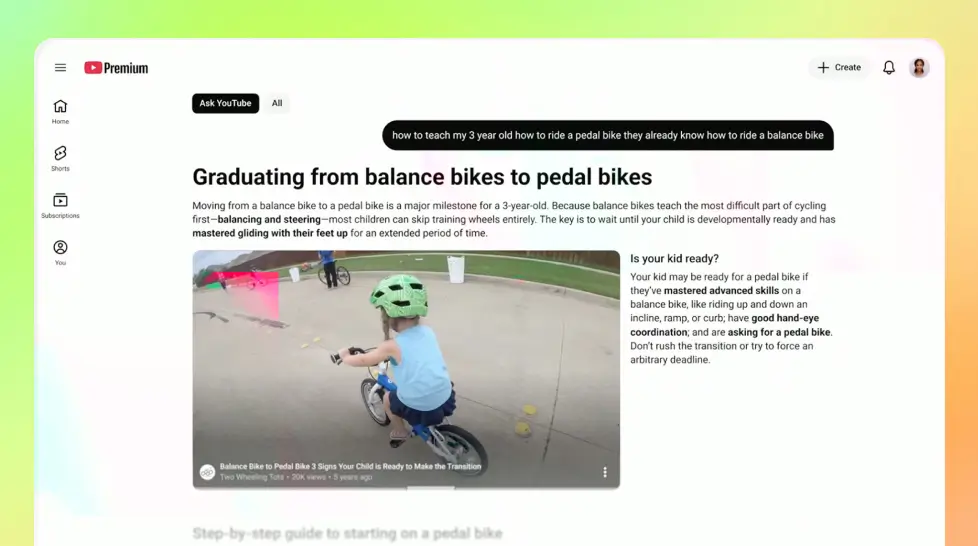
You head to youtube.com/new, tap a new Ask YouTube button in the search bar, and type a question the way you'd text a friend. Google's demo prompt was telling: “How to teach my 3-year-old how to ride a pedal bike, they already know how to ride a balance bike.” That's not a keyword. That's a conversation. Gemini reads the question, writes a short summary, and pulls a curated set of clips. Each clip links directly to the moment inside a video where the answer actually happens. No more scrubbing through a 14-minute tutorial to find the 40 seconds you needed. You can follow up too, the way you would in ChatGPT or Gemini, and the results adjust. It mirrors Ask Maps, the Gemini-powered search layer Google rolled into Google Maps in the US and India. Same playbook, different surface.
Why this matters now
YouTube has been the quiet winner of the AI search era. Research from BrightEdge shows YouTube is cited 200 times more than any other video platform across AI search engines, including ChatGPT, Perplexity, and Google's own AI Overviews. It holds a 20% average citation share across those systems. Google is basically taking the most-cited video corpus on the internet and wrapping a chat interface around it. The scale numbers Google dropped at I/O are wild. The Gemini app now has over 900 million monthly active users, double last year. Google is processing 3.2 quadrillion tokens per month across its AI services, a 7x year-over-year jump. And the company is putting $190 billion into AI capital expenditures in 2026 alone, six times what it spent in 2022. This is not a side experiment. This is the new search.
The engine under the hood
Ask YouTube runs on Gemini 3.5 Flash, also announced at I/O 2026. Google says it's 4x faster than other frontier models in output tokens per second, which is the kind of speed you actually need when a user is waiting for clip results to render inline. Flash, not Pro, makes sense here. Latency matters more than raw reasoning when you're indexing video. Ask YouTube sits inside a much bigger I/O bundle. Google also announced Gemini Spark, a personal agent, Docs Live, and a redesigned Google Search. The pattern is obvious. Every Google surface is becoming a chat window.
The catch
It's gated. You need YouTube Premium, which jumped to $15.99 per month in the US after the April 2026 price hike that took effect in June. You also need to be in the US and 18 or older. International users and free-tier viewers are sitting this one out for now, and Google hasn't said when that changes. There's also the obvious creator question nobody at I/O really answered. If Ask YouTube summarizes a tutorial in text and sends you straight to a 30-second clip, what happens to watch time, mid-roll ads, and the creators whose work powers the answers? Google says clips link back to source videos, so views technically count. But the behavior shift is real, and creators should be watching it.
What creators should do about it
If your videos answer specific questions, chapter markers, accurate titles, and clean spoken content just became more important. Ask YouTube is picking moments, not whole videos. Make those moments findable. And if you're building video content from scratch, AI tools have caught up fast. The
AI Video Generator on MagicShot.ai turns prompts into cinematic clips using Kling Omni, VEO 3.1, Seedance 2.0 and Wan 2.6, useful when you need quick reference footage or a B-roll fill. The bigger story is that YouTube is no longer a place you search. It's becoming a place you ask.