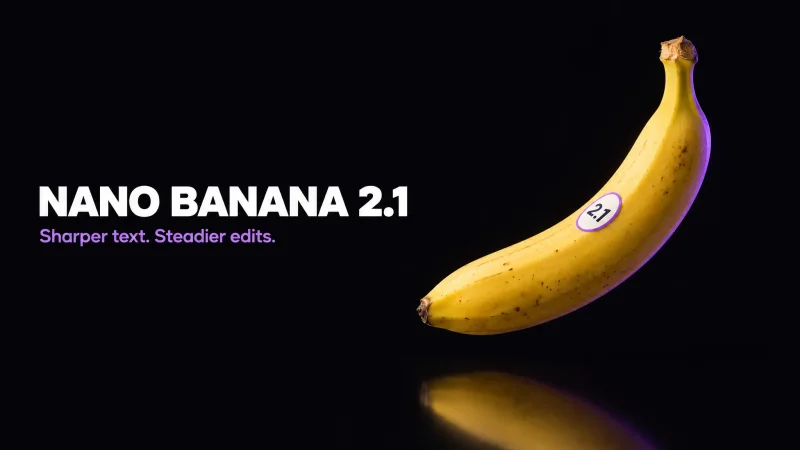

Google has released Nano Banana 2 Lite, the fastest and most cost-efficient model in its Nano Banana image family, and MagicShot has added it to the platform so its creators can generate on it directly. The model, carrying the API ID gemini-3.1-flash-lite-image, shipped alongside Gemini Omni Flash for video and is now the model Google points developers to as the replacement for the original Nano Banana.
The pitch is speed at scale without the frontier-model price tag. Google DeepMind describes it as its lowest-cost image model built for rapid-fire visual exploration, and that is exactly the workload MagicShot users hit every day: a hundred ad variants before lunch, product shots that need three revisions each, avatars generated for entire teams.
What Nano Banana 2 Lite actually is
Nano Banana 2 Lite is Google's entry-level tier in the Nano Banana image family. According to Google's announcement, it is the fastest and most cost-efficient image generation and editing model in that family, aimed at high throughput, speed, and scale. One API handles text-to-image, image editing, and multi-image composition, and because it is a multimodal Gemini model it can return text alongside the picture it makes.
The headline number is time. Google says the model can generate an image in about four seconds, and the DeepMind model card frames that as a dramatic latency cut versus heavier production models. It keeps the parts of Nano Banana people relied on. Character consistency across edits, precise local changes, and the real-world knowledge that keeps a generated scene physically plausible carry over. It just runs them faster and cheaper.
The specs that matter
Model ID: gemini-3.1-flash-lite-image (also branded Gemini 3.1 Flash-Lite Image).
Speed: roughly four-second text-to-image generation, positioned as about 2.7 times faster than Gemini 3.1 Flash Image.
Output: 1K resolution across 14 aspect ratios. Google's documentation notes 2K and 4K are not supported on this tier.
Pricing: about $0.034 per 1K-resolution image on standard pricing, with a lower Batch API rate for high-volume jobs.
Watermarking: every output carries an invisible SynthID watermark so it can be identified as AI-generated.
Why Nano Banana 2 Lite matters for MagicShot users
MagicShot users are time-poor and working without a production budget. The old workflow for a decent product image or a batch of headshots meant a booked studio, a $400 session, and a week of waiting on edits. A model that turns out a usable image in four seconds changes the math on how many ideas you can test before you commit.
That speed pays off most on the jobs where you generate in volume. Think A/B testing ad creative, populating an AI product photo generator workflow with a dozen angles, or spinning up professional headshots for a whole team in one sitting. When each generation costs a fraction of a cent and lands in seconds, you stop rationing attempts and start actually iterating.
Google says Nano Banana 2 Lite can generate an image in as little as four seconds, and lists standard pricing around $0.034 per 1K-resolution image.
Where it fits in the Nano Banana family
Google explicitly positions Nano Banana 2 Lite as the upgrade path for developers still on the original Nano Banana (gemini-2.5-flash-image), calling it the efficiency specialist of the image family. It sits below the heavier Nano Banana and Nano Banana Pro tiers, which stay the choice when you need maximum fidelity or higher resolution output.
The practical read: Lite is for drafting, ideation, and any pipeline that runs at high concurrency, while the larger models handle final, print-grade assets. For a lot of MagicShot work, from stickers to social posts to first-pass concepts, Lite's trade of a cap at 1K resolution for speed and cost is the right one.
The video half of the launch
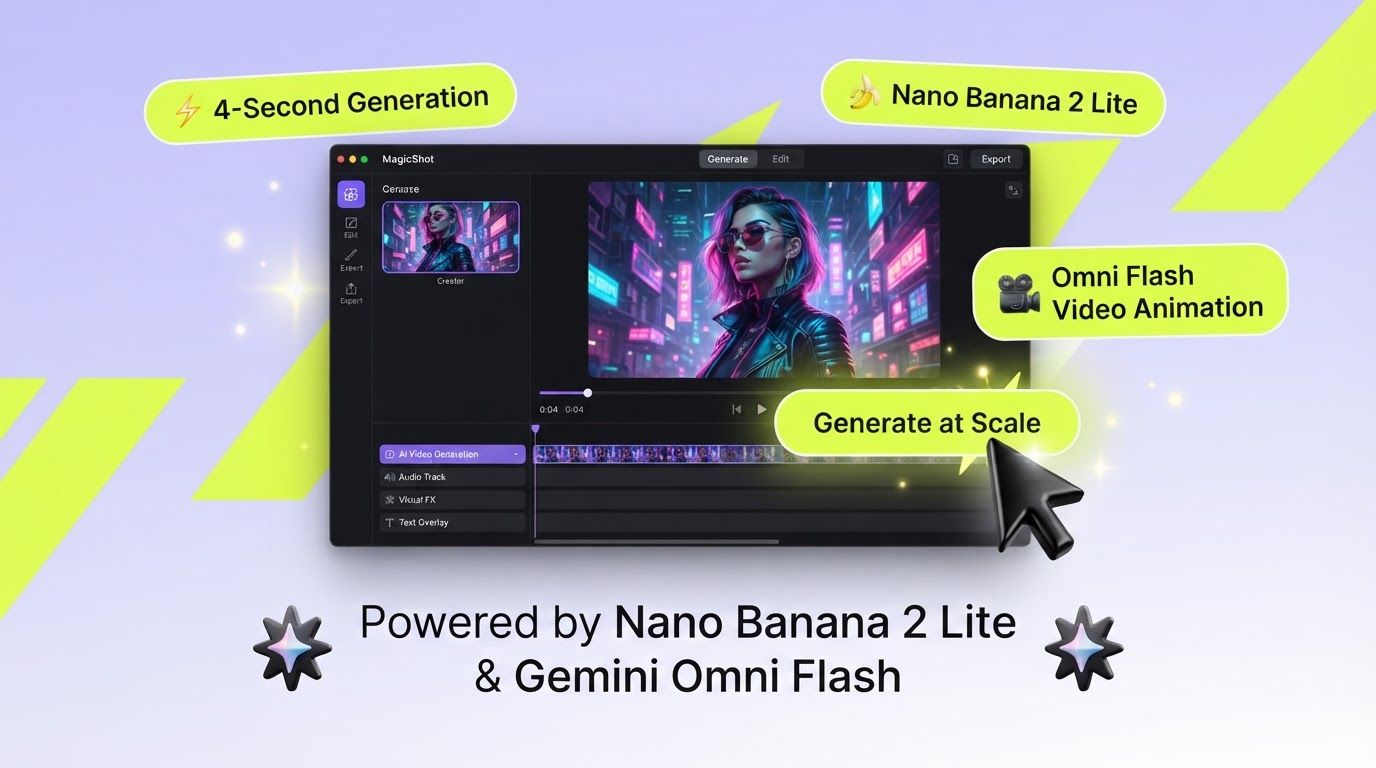
Nano Banana 2 Lite did not ship alone. Google released Gemini Omni Flash in public preview at the same time, a video generation and conversational-editing model. Reports on the launch note Omni Flash lets users change a video with plain-language requests, such as asking for a scene to be more cinematic or to add camera movement, rather than working in complex editing software. At launch it generates clips up to 10 seconds, with longer durations flagged as coming later.
The tie between the two models is the point. Generate a still with Nano Banana 2 Lite, then hand that image to Omni Flash to make it move. That image-to-video chain mirrors how creators already work on MagicShot, moving a single asset from image to video or layering it into AI video effects without leaving the tool.
Where you can already use it
Google is rolling Nano Banana 2 Lite out well beyond a developer API. It is live in Google AI Studio, the Gemini API, and the Gemini Enterprise Agent Platform, and it is reaching consumer surfaces including the Gemini app, AI Mode in Search, Google Photos, NotebookLM, Flow, and Stitch.
On MagicShot, the model is now selectable inside the image tools, so you can point everyday jobs at it directly. Draft a concept in the AI art generator, iterate on a logo, or run a fast AI fashion model shoot, then clean up the result with tools like the background remover or push a favorite frame up in resolution with the image upscaler.
What to watch next
Two things are worth tracking. First, the resolution cap: Lite tops out at 1K, so anything headed for large-format print or high-detail retouching still belongs on a heavier tier. Second, the video side is early. Gemini Omni Flash is in preview with a 10-second ceiling, and Google has said longer clips are on the roadmap.
For now, the story is straightforward. A four-second, low-cost image model that keeps Nano Banana's character consistency and editing control is a genuinely useful default for high-volume work, and it is available on MagicShot today. If your job is testing ideas fast rather than chasing a single flawless frame, this is the model to reach for.