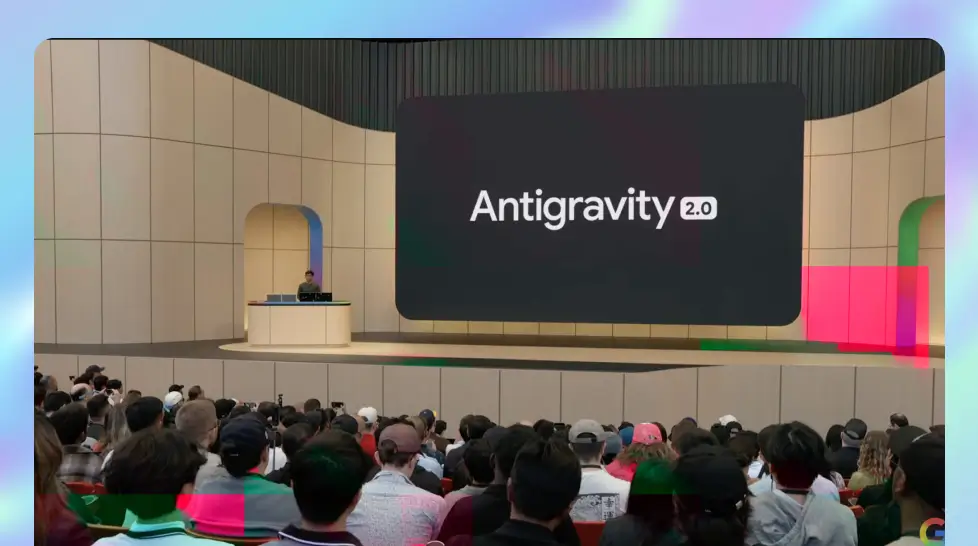
Google just made its biggest move yet in the agentic coding war. At Google I/O 2026 on May 19, 2026 at Shoreline Amphitheatre in Mountain View, Director of Software Engineering Varun Mohan and Logan Kilpatrick of Google DeepMind unveiled Antigravity 2.0, a full rebuild of the agent platform that first shipped in November 2025. And this time it's not just an IDE. It's a desktop app, a CLI, an SDK, a managed agent service, and a new pricing tier all dropping at once. The headline moment? Mohan stood on stage and had Antigravity 2.0's army of parallel agents build a working operating system core from scratch. Token cost: under $1,000. Then he ran a live Doom clone coded directly on top of that brand new OS. Yeah.
The new Antigravity 2.0 desktop app
The standalone desktop application is the centerpiece. It acts as a central hub where you orchestrate multiple AI agents running in parallel, spin up dynamic subagents for split workflows, and schedule tasks to run in the background while you sleep. It plugs into Google AI Studio, Android, and Firebase out of the box. Think of it as a control room for agents instead of a chat window with one.
Antigravity CLI replaces Gemini CLI
This one matters if you're already deep in Google's stack. The new Antigravity CLI fully replaces the old Gemini CLI. Google is asking every existing Gemini CLI user to migrate over. The new tool is lightweight, terminal-native, and lets you build and run agents without ever touching a GUI. If you live in tmux, you're going to like it.
The SDK and Managed Agents
The Antigravity SDK gives you programmatic access to the exact agent harness that powers Google's own internal products. It's optimized for Gemini models and you can host agents on whatever infrastructure you want. Then there's Managed Agents in the Gemini API. With a single API call you spin up a full agent that reasons, uses tools, and executes code in an isolated Linux sandbox. It runs on Gemini 3.5 Flash, which Google says pushes 4x more output tokens per second than other frontier models. Each session is persistent. You can resume it later and your files and state are still there. That's a big deal for multi-turn workflows that used to break every time you closed the tab.
Pricing shakeup: the new $100 AI Ultra plan
Google rolled out a new Google AI Ultra plan at $100 per month with 5x higher Antigravity usage limits than AI Pro. The old top tier dropped from $250 to $200 per month and now offers 20x Pro limits. New and existing Ultra subscribers got $100 in bonus Antigravity credits, though that offer expired May 25, 2026. The pricing math is obvious. Anthropic charges $200 a month. OpenAI Codex Pro sits at $100. Google is matching the market dollar for dollar.
Android vibe coding and the mobile app
Google AI Studio is also getting native Android app building from a single prompt, plus direct Google Play Console integration so you can publish to the test track without leaving AI Studio. A new AI Studio mobile app opened pre-registration the week of May 19, 2026, the idea being you jot down an idea on your phone and come back to a working prototype on desktop. This is the same agent-first philosophy showing up across
no-code platforms like Emergent, where agents handle the heavy lifting and you just describe what you want.
The competition is brutal
Antigravity 2.0 is going head to head with Claude Code, Cursor, Windsurf with Devin, OpenAI Codex, and AWS Kiro. The original Antigravity took heat for quota instability and for Gemini lagging behind Claude on complex reasoning. Google clearly heard that. The 2.0 push is less about being a better VS Code fork and more about owning the infrastructure layer underneath every agent you'll build this year. One honest catch though. Migrating off Gemini CLI is mandatory, not optional, and that's going to sting for teams with production pipelines already wired up.
One more thing: $2M XPRIZE hackathon
Google also announced the Build with Gemini XPRIZE Hackathon at I/O 2026, a global competition with a $2 million prize pool, the largest hackathon prize in history. Finalists pitch live at the Moonshot Gathering in Los Angeles in September 2026. The whole stack from agentic coding to creative pipelines is shifting fast. If you're building visuals on top of this new agent layer, tools like the
AI Video Generator on MagicShot are already plugging into the same prompt-first workflow Google is betting the next decade on.