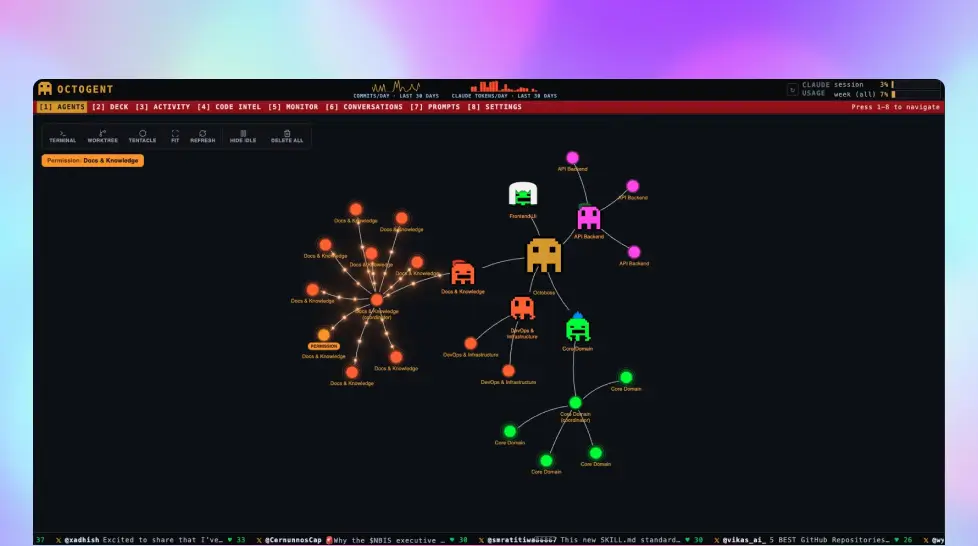
Running five Claude Code sessions at once is a mess. One developer just open sourced a fix. Hesam Sheikh released
Octogent, an open source orchestration dashboard that sits on top of Claude Code and gives you a single view across every parallel AI coding agent you have running. The repo is up under MIT license at github.com/hesamsheikh/octogent and already pulled 472 stars and 79 forks as of early May 2026. If you've been juggling one terminal for the API, one for the frontend, one for docs, and another for the database layer, you know the problem. Sessions lose context. Tasks step on each other. You forget which agent is doing what. Octogent's pitch is simple. Stop scrolling between tmux panes and run the whole swarm from one local web UI.
What Octogent actually does
The core idea is a thing called a
tentacle. Each tentacle is a scoped job container saved at
.octogent/tentacles/<tentacle-id>/, holding a
CONTEXT.md, a
todo.md, and optional notes files. So instead of one giant chat history per agent, every workstream gets its own durable file-based brain on disk. Runtime state, transcripts, and monitor cache live at
~/.octogent/projects/<project-id>/state/. You start the tool and it boots a local API server on port 8787 by default. The web UI opens automatically on first run. From there you can spawn terminals, manage tentacles, toggle todos, message agents, and trigger swarm spawns. There's also git worktree isolation built in, so worktree terminals branch under
octogent/<worktree-id> and your agents don't fight over the same files. Live PTY sessions are capped at 32 by default. You can bump that with the
OCTOGENT_MAX_TERMINAL_SESSIONS environment variable if you really want to go feral. PTY sessions survive browser reloads during an idle grace period. They do not survive an API restart, so don't kill the server mid-run.
Why this matters now
2026 has been the year multi-agent coding workflows went mainstream. The r/ClaudeCode subreddit crossed 4,200 weekly contributors and power users started routinely running five-plus Claude Code sessions in parallel. Tools like Gas Town, Vibe Kanban, Nimbalyst, and Conductor are all chasing the same orchestration problem. Anthropic's own Agent Teams flag exists but it's experimental and has session resumption issues that make it rough for real work. Octogent's angle is that it stays close to Claude Code instead of abstracting it away. It's a thin, file-first layer. The repo is tagged under
dashboard,
ai-agents,
claude,
agentic-workflow,
claude-code,
agent-engineering,
claude-hooks, and
claude-skills, which tells you exactly where it lives in the stack.
Getting it running
Heads up. Octogent is not on the npm registry yet. You install it the old fashioned way. Clone the repo, run
pnpm install, then
pnpm dev. If you want the global CLI, run
pnpm build followed by
npm install -g, and the command becomes
octogent. You'll need Node.js 22 or higher. The codebase is 86.7% TypeScript with CSS for the UI. The catch. Startup fails if you don't have
claude,
git,
gh, and
curl installed. So this is not a beginner's first AI tool. It assumes you already live in Claude Code and have the GitHub CLI configured. Honestly that's the right call for the audience. Octogent integrates directly with Claude Code hooks to feed its API with agent state, transcript data, and idle events in real time. The local REST API covers terminal lifecycle, tentacle management, todo toggling, swarm spawning, inter-agent messaging, and Claude hook ingestion. That last bit is what makes the dashboard feel live instead of just a fancy log viewer.
Octogent vs Claude Squad
Claude Squad is the obvious comparison. It's a terminal multiplexer for Claude Code agents but it has no GUI and no visual context tracking. Octogent gives you both, plus per-tentacle context files you can hand-edit, plus worktree isolation. If you're a solo dev hacking on side projects, Squad is fine. If you're orchestrating a real multi-agent workflow on a real codebase, the dashboard wins. Built by one person, MIT licensed, full source access. The kind of release that quietly shifts how a community works. Expect more lightweight Claude Code orchestrators to ship in the next quarter as the multi-agent pattern eats single-chat coding alive.