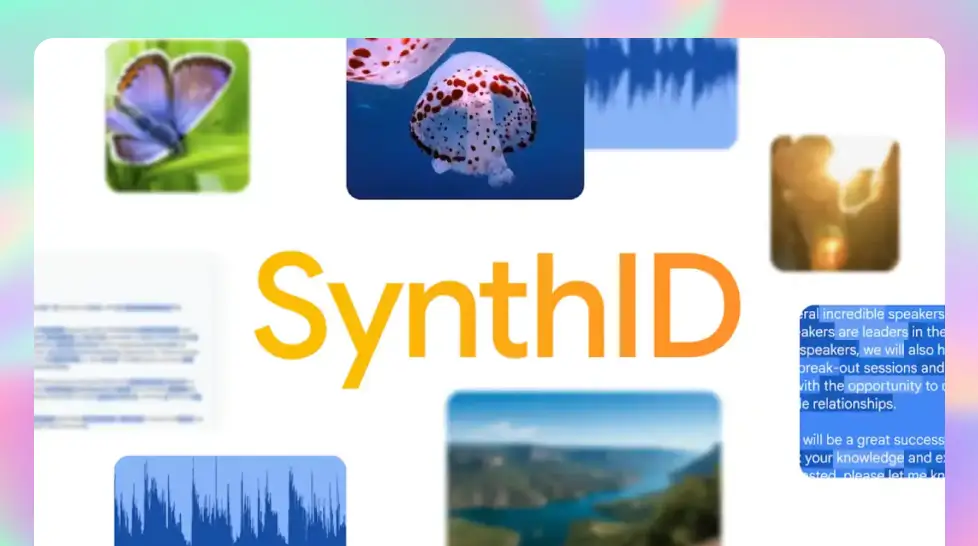
Google just pushed SynthID out of the Gemini sandbox and into the open web. At Google I/O 2026 on May 19, the company confirmed its invisible AI watermark is rolling into Google Search, Chrome, and Circle to Search on Android, with OpenAI, Kakao, and ElevenLabs signing on as adopters. The watermark count is the headline number. SynthID has now tagged more than 100 billion images and videos and 60,000 years worth of audio. No other AI transparency system is close. Here is why this matters if you make or share AI content. Until this week, checking whether something was AI generated meant opening the Gemini app and uploading the file yourself. That verification step happened 50 million times globally. Useful, but not where most people actually look at images. Search is.
SynthID moves into Search, Chrome, and Circle to Search
Starting May 19, SynthID verification began rolling out inside Google Search and Chrome, with the Chrome expansion finishing over the coming weeks. On Android, Circle to Search can now flag AI generated or AI edited images directly. You long press, circle the image, and ask “Is this made with AI?” or “Is this AI generated?” The detection runs against the SynthID signal embedded in the file. That is a big behavioral shift. Detection becomes ambient. You do not need to know what SynthID is to benefit from it.
The SynthID Detector portal opens to journalists
Google also launched the SynthID Detector, a standalone portal that scans uploaded images, audio, video, and text snippets and highlights exactly which portions of the content carry the watermark. Early access is going to journalists, media professionals, and researchers first. There is a public waitlist if you want in. The portal answers the question newsrooms have been asking for two years. Not just “is this AI” but “which part of this is AI.” That matters for partial edits, deepfaked faces inside real photos, and AI generated audio dropped into otherwise real video.
OpenAI, Kakao, and ElevenLabs join the standard
This is the part nobody expected. OpenAI is adopting SynthID, starting with images created through ChatGPT, Codex, and the OpenAI API. Kakao and ElevenLabs are in too. Cross competitor alignment on a single AI safety standard is rare. It almost never happens at the model layer. NVIDIA already integrated SynthID back in January 2026 to watermark video from its Cosmos world foundation models. So you now have Google, OpenAI, NVIDIA, ElevenLabs, and Kakao using the same invisible signal. That is most of the generative stack.
C2PA Content Credentials are coming too
SynthID is not the only system Google is shipping. C2PA Content Credentials support is rolling out in the Gemini app starting May 19, with Search and Chrome following in the coming months. C2PA is a signed metadata standard that proves a file is an unaltered original from a camera, regardless of which AI tool was involved. The Pixel 10 is the first device to write C2PA credentials inside its native camera app. Video credentials are coming to Pixel 8, 9, and 10 over the next few weeks. SynthID and C2PA together cover both ends. One says “this was made by AI.” The other says “this was made by a real camera.”
The catch
SynthID only detects content from models that actually use it. Anything generated by a model that has not adopted the standard sits in a blind spot. The watermarks are durable against cropping, filters, frame rate changes, lossy compression, MP3 encoding, noise, and speed shifts. They are not magic against models that simply do not stamp anything. The text watermark also returns three possible states: watermarked, not watermarked, or uncertain. Short snippets land in uncertain territory more often. Google open sourced the text implementation on Hugging Face with a reference Bayesian detector, so any developer can plug it into their own model without retraining.
Why this hits now
The EU AI Act enters its enforcement phase in August 2026, requiring machine readable disclosure of AI generated outputs. Google shipping SynthID across Search and Chrome three months before that deadline is not a coincidence. It is regulatory positioning at planetary scale. Google also launched an AI Content Detection API on the Gemini Enterprise Agent Platform inside Google Cloud, aimed at feed moderation and insurance fraud teams that need to flag AI content from any major model, not just Google ones. If you make AI video on tools like MagicShot’s
AI Video Generator, expect watermark status to start showing up next to your content in Search results, Chrome image inspectors, and Android Circle to Search. The smart move is treating provenance signals as a feature, not a tax. The next year of AI media is going to be judged on transparency as much as on quality.