


Google Veo 4 Leaks: Multi-Camera AI Video Hits I/O 2026
- AI News
- 4 min read
- Published: May 17, 2026
- Harish Prajapat
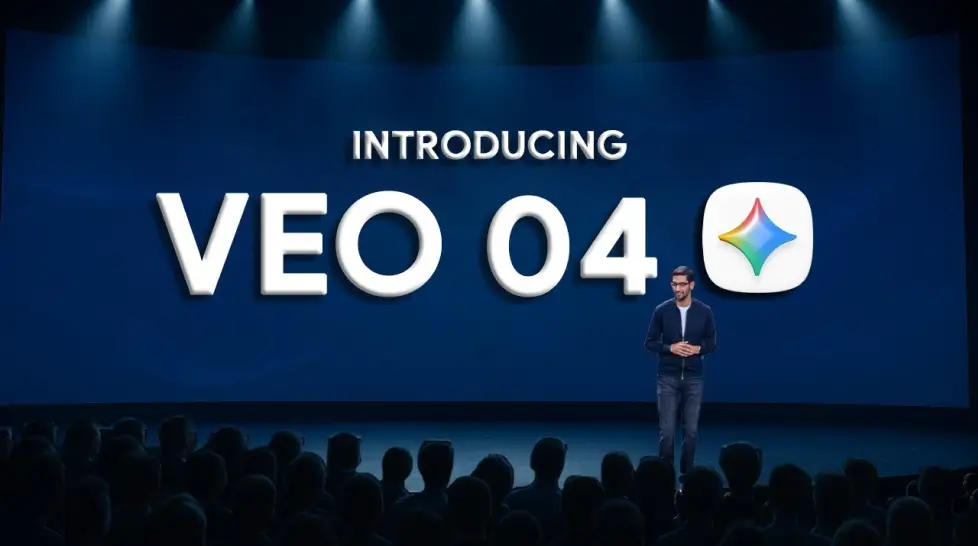
Leaked Veo 4 clips just made every other AI video model look stuck in 2024. Multi-angle scene generation. Dynamic camera switching inside a single clip. Audio that actually syncs without a second pass. And it’s all pointing straight at Google I/O 2026.
What the Veo 4 leaks actually show
The headline upgrade is dynamic camera switching. Scenes change perspective mid-clip while keeping the subject, lighting, and motion coherent. Wide shot to close-up. Over-the-shoulder to reaction. All generated in one pass.
That’s the thing every current AI video model can’t do.
Veo 3.1, Seedance 2.0, Kling 3.0, Sora 2. Every one of them gives you a single camera per generation. Want a cut? Generate two clips and stitch them in a real editor. That single-camera ceiling is the biggest friction point in AI filmmaking right now, and Veo 4 looks built specifically to break it.
Leaked examples show clip length pushing to around 9 seconds at 720p resolution. Audio quality is dramatically improved with synchronized dialogue, ambient sounds, and contextual background music generated natively. One model. One pass. Full scene.
Analysts who’ve seen the leaked outputs describe them as “very impressive,” though some continuity issues remain between angle switches. Expected. This is pre-release leak footage, not a finished product.
Why this matters for creators
If you’re using AI video for ads, shorts, or any narrative work, the manual stitching workflow is the bottleneck. You generate, you cut, you sync audio separately, you hope the lighting matches between shots. Multi-camera generation collapses that whole pipeline into one prompt.
For indie creators and ad agencies, that’s hours saved per spot. For content studios running at scale, it changes the unit economics of AI video entirely.
You can already test the current generation of multi-shot workflows using a multi-model AI video generator that runs Veo 3.1, Seedance 2.0, Kling Omni, and Wan 2.6 in one place. Veo 4 will slot in once Google releases the API.
[IMAGE: Split-screen comparison showing a single static AI video frame on the left labeled Veo 3.1, and a four-panel multi-camera scene with synchronized angles on the right labeled Veo 4 leak]
Then there’s Gemini Omni
Veo 4 isn’t the only thing leaking. On May 2, 2026, X user @Thomas16937378 spotted a new model called Gemini Omni inside the Gemini video generation tab. The UI string read “Start with an idea or try a template. Powered by Omni.” AI leak tracker TestingCatalog verified the find.
Gemini Omni appears staged alongside “Toucan,” the internal codename for the existing Veo 3.1-powered pathway inside Gemini. The expectation is that Omni unifies text, image, and video generation into a single model. That would be a first for any top-tier AI system.
Right now Google runs a fragmented creative stack. Veo 3.1 handles video. Nano Banana handles images. Standard Gemini handles text. Omni collapses all three.
Veo 4 vs Seedance 2.0
Seedance 2.0 from ByteDance currently leads public AI video benchmarks for motion quality and multi-shot narrative storytelling. That’s the bar Veo 4 has to clear.
For reference, Veo 3.1 currently generates 4-to-8-second clips at 720p, 1080p, or 4K at 24 frames per second with audio at 48kHz stereo. Pricing through the Gemini API runs $0.40 per clip standard, $0.15 Fast, and $0.05 Light.
Veo 4 pushes to 9 seconds at 720p in leaks, with the multi-camera capability as the real differentiator. Resolution at higher tiers wasn’t shown. Pricing wasn’t leaked either, and that’s the catch worth flagging. Multi-camera generation is computationally heavier than single-camera. Don’t be shocked if the top tier costs more than $0.40 per clip when it ships.
Honestly though? If it actually delivers true scene-level camera switching, most creators will pay it.
The pre-I/O wave
Veo 4 and Gemini Omni aren’t dropping in isolation. Gemini 3.1 Flash-Lite already launched in General Availability on May 8, 2026 as part of the same pre-I/O model update wave. Google’s clearly staging a packed keynote.
Watch May 19-20 closely. If the multi-camera demos on stage match the leaks, the AI video benchmark conversation resets that morning.
Frequently Asked Questions
Google Veo 4 is the unreleased next version of Google DeepMind’s AI video model. Leaks ahead of Google I/O 2026 show it generating multi-camera scenes with dynamic angle switching, longer clips of around 9 seconds at 720p, and improved synchronized native audio in a single pass.
Veo 4 is expected to be announced at Google I/O 2026, scheduled for May 19-20, 2026 at Shoreline Amphitheatre in Mountain View, California. Google has not confirmed availability or pricing yet.
Seedance 2.0 from ByteDance currently leads public AI video benchmarks for motion quality and multi-shot storytelling. Leaked Veo 4 examples show true multi-angle scene generation inside one clip, which Seedance 2.0 cannot do natively, making Veo 4 a direct threat to its lead if the released model matches the leaks.