


Google Universal Cart Brings AI Checkout to Search and Gemini
- AI News
- 5 min read
- Published: May 19, 2026
- Harish Prajapat
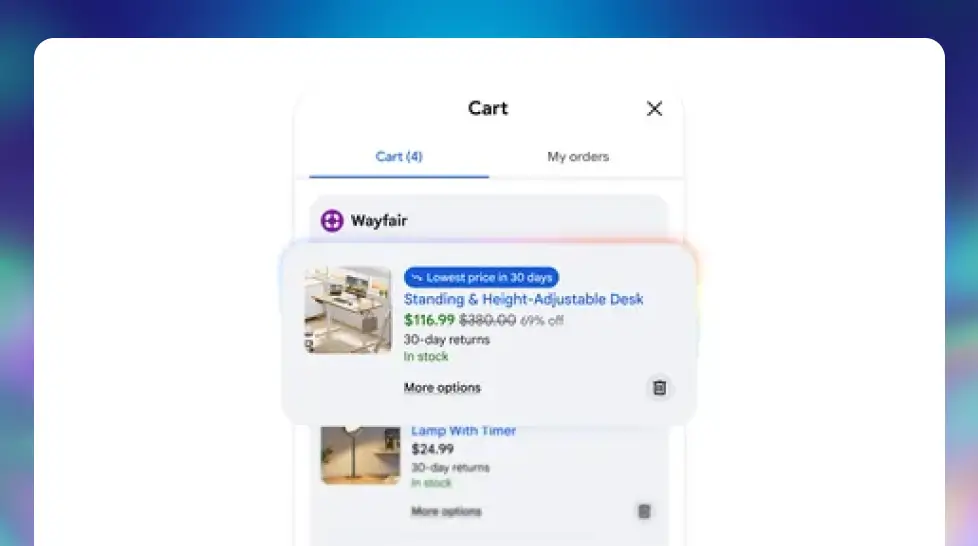
Google just turned its entire product stack into one shopping cart. On May 19, 2026, at Google I/O 2026, the company introduced Google Universal Cart, an AI-powered shopping layer that follows you across Search, the Gemini app, YouTube and Gmail.
The U.S. rollout starts this summer across Search and Gemini. YouTube and Gmail come later. And the whole thing runs on Gemini reasoning, Google Wallet, Google Pay, and two new agent standards called Universal Commerce Protocol and AP2.
Why it matters. Online shopping has been a mess of tabs, retailer logins, promo emails and abandoned carts for years. Google is now collapsing all of that into a single persistent cart that knows what you saved, what dropped in price and what just came back in stock.
What Universal Cart actually does
You can add items to one cart whether you are searching for sneakers, asking Gemini to compare laptops, watching a YouTube review or reading a promo in Gmail. The cart syncs everything. It finds deals, monitors price drops, shows price history and pings you when sold-out stuff is available again.
Gemini handles the reasoning part. Google demoed it checking custom PC part compatibility and suggesting alternatives when something does not fit. Google Wallet feeds in the boring but useful data: which card gives you the best perks at which merchant, what loyalty program applies, which offers are stackable.
Checkout happens one of two ways. Either through Google Pay in a couple of taps with participating brands, or by sending the cart over to the merchant site to finish there. The brand stays the merchant of record. Google is the plumbing, not the seller.
The scale claim is big. Google says people shop across its services more than 1 billion times a day. Its Shopping Graph now holds more than 60 billion product listings. That is the inventory layer the cart pulls from.
Who is plugged in at launch
Google named Nike, Sephora, Target, Ulta Beauty, Walmart, Wayfair, Fenty and Steve Madden among brands and Shopify merchants connected to select checkout features. That is a real lineup. Not vaporware partner logos.
The international plan is staged. UCP-powered checkout expands to Canada and Australia in the coming months, with the U.K. after that. UCP is also coming to YouTube in the U.S. and will move into new verticals starting with hotel booking and local food delivery.
UCP and AP2, explained without the jargon
Universal Commerce Protocol is the part most retailers actually care about. Google co-developed it with retail partners as a shared language so shopping agents from any platform can read inventory, pricing, promos and checkout flows the same way. Think of it as the API contract every AI shopping assistant has been missing.
AP2 is the payments side. It handles how an autonomous agent presents a payment instrument, gets authorization and completes a purchase on your behalf without you having to retype your card on every site. Together UCP plus AP2 is what makes agentic checkout possible at scale.
This is also where the competitive picture gets interesting. OpenAI has its own Agentic Commerce Protocol built with Stripe, anchored to ChatGPT. Amazon has Rufus pushing recommendations inside its own walled garden. Microsoft has Copilot Actions. Google’s pitch is different. It already owns the surfaces, Search, YouTube, Gmail, Android, where people actually browse, watch and check email. Universal Cart turns those into the shopping floor.
The honest catch
This only works if retailers play along. UCP is open and Google has heavyweight names on board, but smaller brands and independent stores have to actually integrate before the cart works everywhere. Until then expect a patchy experience where Google Pay one-tap checkout works at Target but kicks you to the merchant site at smaller shops. Also worth flagging: agent-driven buying still raises real questions around refunds, disputes and what happens when the AI picks the wrong size.
What this means for creators and sellers
If you sell anything online, your product visuals just became more important, not less. Shopping agents do not browse the way humans do. They scan structured data, images and reviews to decide what to surface to a buyer. Clean catalog photos, accurate angles and strong lifestyle shots feed directly into how an agent ranks your product against competitors.
That is the same shift that has been pulling sellers toward AI product photography for the last year. Studio-quality shots without renting a studio, multiple angles on demand, lifestyle scenes you can generate in minutes. When a Gemini agent is comparing your listing to ten others inside Universal Cart, the listing with sharper, more consistent visuals wins the click.
For broader context on why this visual layer matters for online stores, this breakdown of AI-generated product photos and e-commerce sales is a useful read.
What to watch next
Three things to track over the next few months. One, how many Shopify merchants actually flip on UCP checkout once the rollout widens. Two, whether YouTube shopping turns into a real revenue stream now that the cart persists across watch sessions. Three, the response from Amazon, which has every reason to keep its catalog out of any cross-platform agent protocol it does not control.
Universal Cart is Google’s clearest bet yet that the next decade of e-commerce belongs to whoever owns the agent, not the storefront.
Frequently Asked Questions
Google Universal Cart is an AI shopping hub that lets you add products to a single cart while using Search, Gemini, YouTube or Gmail. It uses Gemini for reasoning and Google Pay for checkout, and it can track price drops, restocks and deals across retailers.
Google announced Universal Cart on May 19, 2026 at Google I/O 2026. It rolls out in the U.S. across Search and the Gemini app in summer 2026, with YouTube and Gmail support arriving later. UCP-powered checkout is expanding to Canada and Australia in the coming months and the U.K. after that.
Google named Nike, Sephora, Target, Ulta Beauty, Walmart, Wayfair, Fenty and Steve Madden among brands and Shopify merchants connected to select checkout features. The brand still acts as the merchant of record when you buy.